
NEWS
Silica Dust Keeps Killing Miners After the Rule Was Stayed
A stayed 2024 mine silica rule and a House bill to block quartz lawsuits leave Appalachian miners and Latino fabricators paying in scarred lungs.

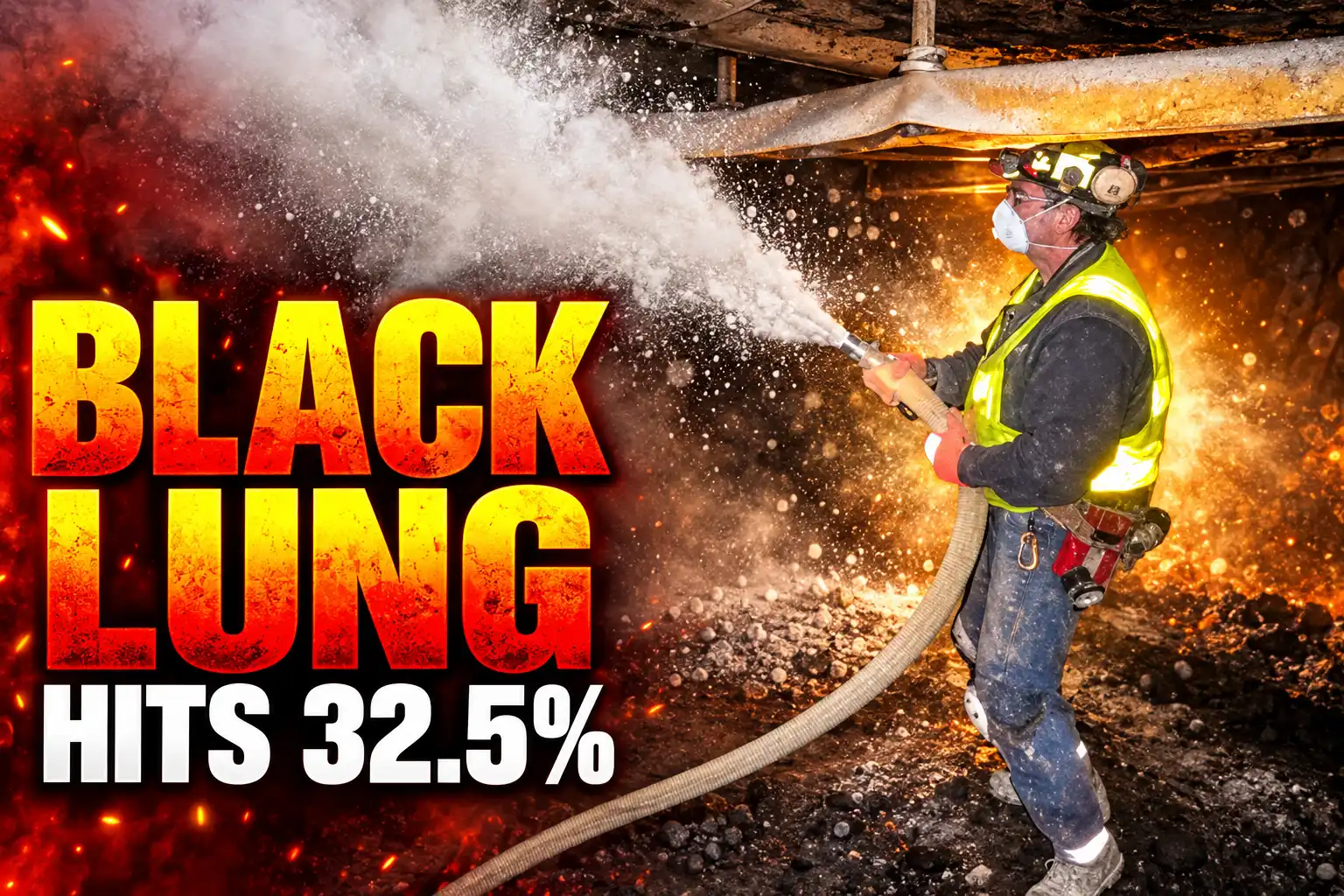
NIOSH X-rays of veteran underground coal miners in Kentucky, Virginia and West Virginia now show black lung in 32.5%, a rate last matched in 1978. The same silica dust is tearing through a second workforce, the Latino men who cut quartz slabs into kitchen counters.
A 2024 mine rule that cut the legal silica limit in half is stayed in the Eighth Circuit. In the House, a bill would wipe out lawsuits against the companies that make and sell those slabs. The dust is still in the air. The argument in Washington is over who pays after the lungs are already gone.
One in Three Veteran Miners Now Has Black Lung
The figure comes from a research letter that NIOSH epidemiologist A. Scott Laney and colleagues published in August 2026 in the American Journal of Respiratory and Critical Care Medicine. Over the prior five years the agency X-rayed 280 working underground miners with at least 25 years in central Appalachia. Ninety-one screened positive for coal workers’ pneumoconiosis.
That is 32.5% of that veteran group. In 2018 the same tenure in the same three states sat at 20.6%. In 1999 it had fallen to 7%, a low reached 30 years after the Coal Mine Health and Safety Act of 1969. Outside central Appalachia, miners with the same 25-year underground history now sit at 3.9%.
HOW THE RATE MOVED
| Period | Central Appalachia, 25-plus years underground | Notes |
|---|---|---|
| 1978 | 32.5% | Last time the veteran rate hit this mark |
| 1999 | 7% | Low point after the 1969 dust law |
| 2018 | 20.6% | Prior NIOSH report on the same group |
| Last five years | 32.5% | 91 of 280 working miners X-rayed |
| Same tenure, rest of U.S. | 3.9% | NIOSH comparison in the 2026 letter |
An earlier NIOSH count found more than 1,700 coal miners died of black lung from 2020 through 2023. Clinic doctors say they are seeing the disease in men with far shorter careers than their grandfathers had. John Robinson, who mined in southwest Virginia, was diagnosed at 47. His grandfather lasted into old age before the same diagnosis.
I’m disgusted. This is not going to get better because of all the disease that’s already in the pipeline. These guys are being treated like disposable widgets, not human beings.
A. Scott Laney, NIOSH research epidemiologist, lead author of the 2026 surveillance letter
The driver is not mystery coal dust from the 1980s. As the thick seams ran out, operators cut thinner bands and chewed through quartz-bearing rock. Silica is about 20 times more toxic than coal dust alone. Laney said researchers have seen the particles in lungs taken at autopsy and after transplant.
The National Mining Association’s Ashley Burke said the new X-rays capture exposures from years and, in many cases, decades ago, and do not reflect conditions in mines now. Association figures put nationwide compliance with existing silica limits above 90% over the last decade, and at 97% last year. A high compliance rate still leaves thousands of overexposures. Those spikes cluster where the thin seams are, in the same counties filling the black lung clinics.
The Countertop That Costs Workers Their Lungs
Engineered stone, sold as quartz, is crushed natural quartz bound with resin and pigment. The slabs typically hold more than 90% crystalline silica. Fabricators who cut, grind and polish them inhale a dust load that older granite shops never produced. Global demand made the material the most popular countertop in the United States.
A report published August 12, 2026, in NEJM Evidence, with the California Department of Public Health, UCLA, UCSF and David Michaels of George Washington University, counted 592 silicosis cases in California shops from January 2019 through June 2026. Sixty-five workers received lung transplants. Thirty-one died. One hundred thirty-eight were referred for transplant.
CALIFORNIA ENGINEERED-STONE SILICOSIS
- Cases: 592 confirmed from January 2019 through June 2026.
- Transplants: 65 workers, or 11%, with 138 referred.
- Deaths: 31 workers, median age 52.
- Who: 591 men, 580 Latino, median age at diagnosis 46, median 22 years on the tools.
CDPH’s first known case was a man diagnosed at 32 who died of respiratory failure at 38. Investigators then found two more former workers at the same company, one already dead, and five more cases among 43 current employees. Around 2018, clinics had already flagged seven workers in Colorado and 12 in Texas.
In 2024 Cal/OSHA inspected only 85 of more than 1,300 countertop shops in the state. Ninety-five percent of those inspected were in violation. Wet saws and hoods are expensive to keep running. Overexposures still happen when the controls are in place. In Queensland, where current and former fabricators were offered screening, more than 25% received a silicosis diagnosis.
Michaels, who ran OSHA from 2009 to 2017, has said the 2016 federal silica rule is not enough for a product this rich in quartz, and that many small shops are out of compliance anyway.
This product cannot be made in a way that’s both economic and safe. There are substitute products that are comparable in use and cost, but which do not kill workers.
David Michaels, epidemiologist and former OSHA assistant secretary, congressional testimony
Why the 2024 Silica Rule Never Took Hold
NIOSH told the government in 1995 to put a silica rule on coal miners. MSHA’s 2024 standard, titled Lowering Miners’ Exposure to Respirable Crystalline Silica and Improving Respiratory Protection, lowered the silica limit to 50 micrograms per cubic meter of air over an eight-hour shift, down from 100. That matches the OSHA limit set in 2016 for other industries. The rule also tightened sampling, required no-cost medical exams, and put engineering controls ahead of respirators and job rotation.
MSHA’s own impact analysis estimated that once miners had worked only under the new limit, the rule would avoid 1,067 deaths and 3,746 silicosis cases. It priced compliance at about $89 million a year in 2022 dollars and put undiscounted net benefits near $294 million a year.
THE RULE THAT WAS STAYED
- April 18, 2024: MSHA publishes the final silica rule in the Federal Register.
- June 17, 2024: New Part 60 takes effect; coal operators face an April 14, 2025, compliance date and metal and nonmetal mines April 8, 2026.
- April 11, 2025: The Eighth Circuit stays the compliance deadlines after petitions led by the National Stone, Sand & Gravel Association, with the National Mining Association and the American Exploration & Mining Association among those joined.
- November 26, 2025: Labor Department lawyers tell the court MSHA will run limited rulemaking to reconsider portions of the rule the industry challenged.
- April 6, 2026: MSHA delays the metal and nonmetal conforming amendments indefinitely while the stay holds. A June 2026 program bulletin says the old coal and nonmetal standards remain the ones being enforced.
NSSGA, through communications director Kerry Lynch, said it did not oppose cutting the exposure limit. Before the rule was finished the group objected to the sampling frequency and the medical surveillance. AEMA executive director Mark Compton said the association supports a lower limit but called the 2024 package an inflexible, cookie-cutter approach. He said engineering controls are not always technically or economically feasible and that job rotation and respirators should count toward the new cap.
That is the swap the rule was written to block. A respirator is a last layer. Rotation spreads the dose across more chests. The 2024 text treated both as backup, not as the plan.
House Republicans Move to End the Suits
On the countertop side, the federal fight is not over a new exposure number. OSHA’s 2016 silica rule already sits at 50 micrograms. Industry groups including NSSGA sued when it landed, calling the science unsound. The product kept selling. The cases kept accumulating in California shops, and workers began suing manufacturers, distributors and big-box sellers.
In January 2026 a House Judiciary subcommittee heard those cases as a litigation problem. Chair Darrell Issa of California opened by describing “the troubling rise in abusive litigation against the US stone slab industry.” Michaels was the only witness who was not there for industry. He told the panel the United States should stop selling high-silica engineered stone, the step Australia had already taken.
Rep. Tom McClintock of California had introduced H.R. 5437, the Protection of Lawful Commerce in Stone Slab Products Act, on September 17, 2025. Issa is among 16 Republican cosponsors. The bill would bar federal and state suits against manufacturers or sellers for injuries from someone else’s fabrication, including silica exposure, and it would dismiss pending stone-slab injury suits on the day it became law. The Judiciary Committee ordered the bill reported, 16-7, on June 3, 2026. It has not passed the House.
McClintock has said stone-slab manufacture produces $30 billion a year and employs 100,000 people, and that a finished slab is safe if the shop follows the rules. The U.S. Chamber Institute for Legal Reform backed the bill in a June 24, 2026, letter, calling the suits a misuse of the courts against parties who do not control the shop floor. That is the same split the dust science keeps failing: the hazard is built into a 90% silica slab, and the legal theory treats the slab as inert until a small shop mishandles it.
California Tries the Ban Australia Already Made
On May 21, 2026, California’s Occupational Safety and Health Standards Board voted 3-0 to grant Petition 609 from the Western Occupational and Environmental Medical Association. The vote directs Cal/OSHA to start emergency rulemaking that would prohibit fabricating and installing artificial stone with more than 1% crystalline silica, and to run advisory committees in parallel. Only three of seven board seats were filled. The vote is not a ban. A later standard would still need approval.
Manufacturers including Cosentino and Cambria argued for a fabricator certification program and more inspections instead. Cosentino told Cal/OSHA a prohibition rested on inaccurate science, was unnecessary, was not feasible, and exceeded the board’s authority. Matt Thurston of Cosentino North America told the board that banning a product to make up for failed enforcement was the wrong move.
California already treats the work as extreme. State rules define high-exposure trigger tasks for artificial stone that contains more than 0.1% crystalline silica by weight, covering cutting, grinding, polishing and related machining. Senate Bill 20, fully in force January 1, 2026, banned dry cutting and required shop certification. Case counts kept rising anyway, which is why the medical association asked for a product line to come off the saw.
TWO ANSWERS TO THE SAME SLAB
- Australia, July 1, 2024: Australia banned engineered stone benchtops, panels and slabs for manufacture, supply, processing and installation, after WHS ministers agreed in December 2023. A December 2025 Safe Work Australia review found firms had stopped supply and were moving to products under 1% silica.
- California, May 21, 2026: The standards board starts emergency rulemaking toward the same 1% line, with no final prohibition in force.
- Washington: The House bill would close the courtroom. The 2016 OSHA limit remains the federal floor, with no engineered-stone ban on the books.
Michaels has said manufacturers will have to shift to silica-free slabs if other regulators copy Australia. Some already sell lower-silica and amorphous-silica lines. Cambria, the largest U.S. maker, has not, and has pushed certification instead.
Dust Readings Still Break the Paused Cap
The mining industry’s line is that today’s mines are not producing today’s disease. Rebecca Shelton, policy director at the Appalachian Citizens’ Law Center, went to the samples MSHA still takes under the old standard. In a report sent to Congress in spring 2026, she found that 20% of surface and underground mines sampled for silica in 2025 had readings over the 50-microgram cap in the stayed rule.
That 2025 set covered 389 mines and 4,808 samples. One hundred thirty-five samples topped 50 micrograms. Sixteen topped 100, the old legal ceiling. Twelve mines came in at more than double the paused limit. Early 2026 inspections tracked the same pattern: of mines sampled in the first quarter, 16, or 20%, exceeded 50 micrograms, and six exceeded 100. Most of the hottest readings were in Kentucky and West Virginia.
The 20% is a share of mines, not of every sample. Most readings still land under the paused cap. The point of a mine-level rate is that a worker does not breathe an industry average. He breathes the heading where the continuous miner is cutting rock.
Dr. James Brandon Crum, a radiologist in Coal Run Village, Kentucky, drove 3.5 hours to a NIOSH meeting more than a decade ago to say he was seeing complicated black lung in men who should have been too young for it. He has logged hundreds of cases since. He said the 2024 rule could have prevented new ones. Marcy Freeman, a respiratory therapist in Norton, Virginia, keeps a stack of more than 150 funeral programs for former patients.
Tim Balthis, a former miner and foreman with complicated black lung at 57, described silica underground as dust in a sunbeam, multiplied until it is fog. The 2024 rule was supposed to pull that fog down. It is still on the books. It is not being enforced. The quartz version of the same particle is still being cut in shops that California has already called out, while a House bill would take the manufacturers out of court.
Crum’s line from the coalfields still fits both jobs. “We continue to show every single year just how bad this is and nothing ever gets done about it,” he said. “The only thing higher than our black lung rates is the amount of excuses.”
Disclaimer: This article is news reporting on published studies, agency rules, court orders and legislation. It is informational only and is not medical, legal or workers’ compensation advice. It does not diagnose lung disease, assess any person’s claim, or tell employers or workers how to comply with MSHA, OSHA or Cal/OSHA standards. Readers who have been exposed to silica or coal mine dust, or who are considering a legal claim, should consult a qualified physician and an employment or occupational-disease attorney licensed in their state. Case counts, sampling rates, bill status and enforcement dates reflect the sources cited and can change as surveillance, rulemaking and litigation move.

Netflix Cancels the Belfast Hit America Never Ranked

The Fine for Hitting Josh Allen Came In Under Sticker

Samsung Puts Foles and Matthews on the Therapy Couch

Silica Dust Keeps Killing Miners After the Rule Was Stayed

Chris Larsen Wants the Clarity Act, Ethics Fight and All

Nvidia’s $3.5 Billion MediaTek Deal Keeps Custom Chips Close

Pittsburgh Keeps Four Quarterbacks and Still Lacks a Successor

Tony Romo’s OWI Plea Follows Him Into Every Car

Pelacarsen Miss Hands the Lp(a) Bet to Amgen

POET Takes CPO Lasers to Shenzhen’s Optics Floor
-
 NEWS1 month ago
Nvidia’s $3.5 Billion MediaTek Deal Keeps Custom Chips Close
-
 NEWS1 month ago
Pittsburgh Keeps Four Quarterbacks and Still Lacks a Successor
-
 NEWS1 month ago
Tony Romo’s OWI Plea Follows Him Into Every Car
-
 NEWS4 weeks ago
Pelacarsen Miss Hands the Lp(a) Bet to Amgen
-
 NEWS3 weeks ago
POET Takes CPO Lasers to Shenzhen’s Optics Floor
-

 NEWS4 weeks ago
Shopify’s AI Push Pays Off Through Payments Mix
-

 NEWS3 weeks ago
Australia’s Feed Prompts Leave the Algorithm Switched On
-

 NEWS3 weeks ago
Health-ISAC Warns ShinyHunters Is Walking Through Hospital Logins