
NEWS
Tony Romo’s OWI Plea Follows Him Into Every Car
Tony Romo’s no-contest OWI plea adds a six-month license hit and a yearlong interlock that Wisconsin says also blocks ordinary rental cars before CBS’s opener.

Tony Romo pleaded no contest Tuesday to a first-offense OWI in Milwaukee County, and a Wisconsin court revoked his license for six months. The same order requires an ignition interlock on any vehicle he owns, operates, or registers, for at least a year after that license is reissued.
He is 46, a former Dallas Cowboys quarterback, and CBS Sports’ lead NFL game analyst on leave. The plea closed a July ticket. It also handed a traveling broadcaster a device that Wisconsin says follows him into cars that are not his.
Six Months off the Road, a Year on the Box
Online court records updated Sept. 1 show Romo entered a no-contest plea to operating while intoxicated, first offense. A no-contest plea does not admit guilt. It lets the court impose the penalty anyway. Three other pending forfeitures were dismissed the same day.
Milwaukee Journal Sentinel review of those records listed a $748 fine due Nov. 2. Other docket copies circulating the same day listed $784. State law also imposes a $50 ignition interlock surcharge when a court enters that order. If the money is not paid, the court can extend the license hit to a year.
The records further order completion of the Alcohol Assessment Program. Romo’s lawyer, Julius Kim, had been the contact for local inquiries; the plea was entered in court Tuesday, ahead of a Sept. 21 date that had been on the calendar since the summer.
THE SEPT. 1 COURT ORDER
| Item | What the court set |
|---|---|
| License | Revoked for six months |
| Ignition interlock | Any vehicle owned, operated, or registered to him, for at least one year after the license is reissued |
| Money | $748 due Nov. 2 in Milwaukee records (other copies list $784), plus a $50 interlock surcharge |
| Program | Alcohol Assessment Program |
| Other citations | Three companion forfeitures dismissed |
The Milwaukee County OWI case file is docketed as 2026TR016533. Companion files covered a refusal citation, unsafe passing on the right, and possessing open intoxicants. Those three did not survive the plea.
An Interlock Order Follows Him Into Rental Lots
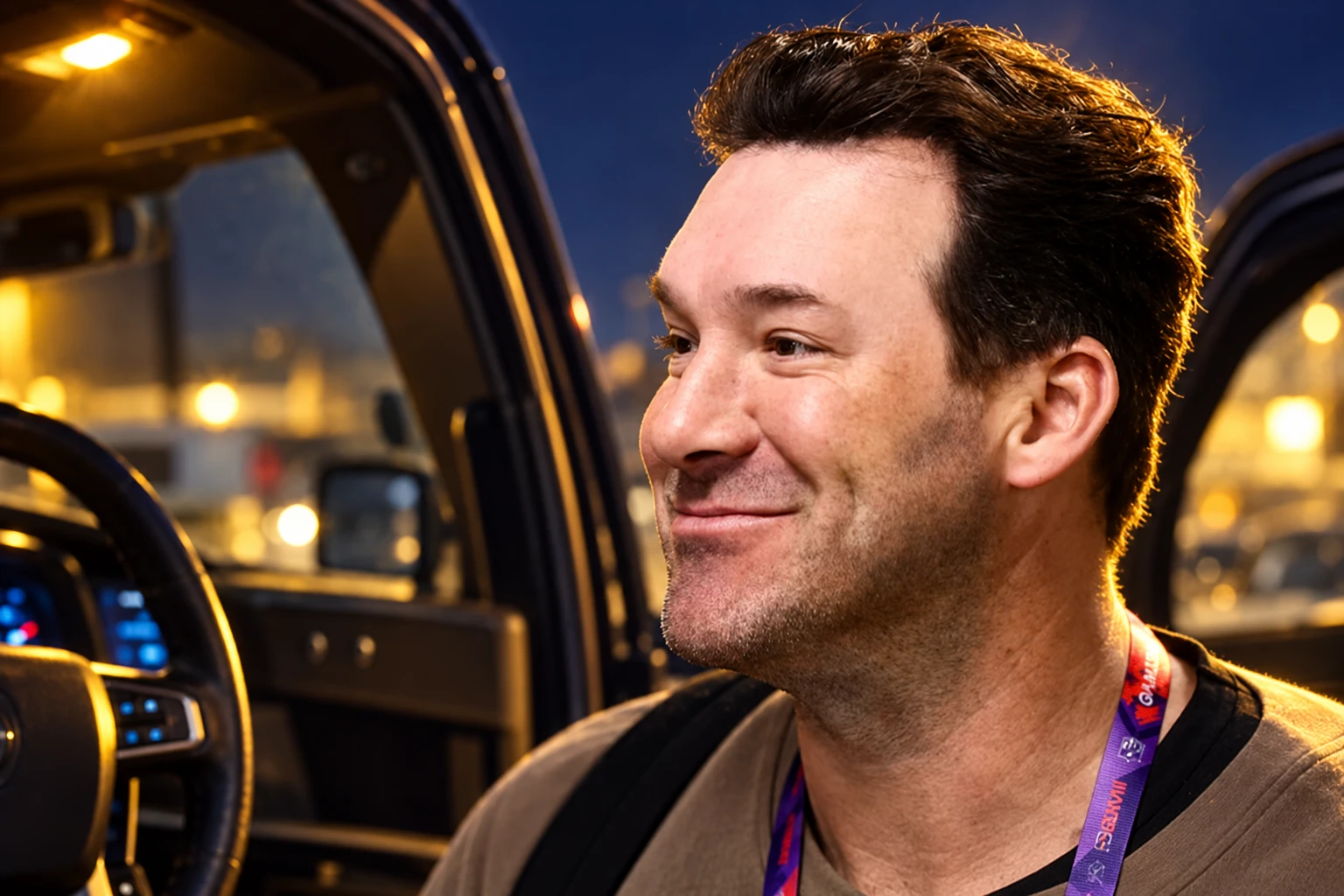
The six-month revocation is the line that travels. The harder limit is the box on the column. Wisconsin’s Department of Transportation tells offenders the device must go in every Class D vehicle that carries their name on the title or registration, unless a judge carves out an exemption. The driving privilege itself is then restricted to equipped cars. Judges cannot waive that operating restriction.
DOT guidance is blunt about a job that lives in airports. Asked whether someone who travels for work may rent a car, the department says the license allows only interlock-equipped vehicles. Unless the rental desk has one, the offender cannot legally operate the vehicle.
A lead NFL analyst can ride a car service, a production runner, or a colleague. That is not the same as a clean Class D privilege in a new city every Sunday. The order also follows any car he registers later. DOT says a new registration without proof of installation brings a 15-day warning, then a canceled license.
WHAT THE DEVICE REQUIRES
- Every titled car: Each Class D vehicle with his name on the title or registration must carry an interlock unless the court exempts it.
- Only equipped cars: He may not legally drive a regular Class D vehicle that lacks the device while the order is in force.
- Rentals: Unequipped rental cars are off limits under the same operating restriction.
- No waiting it out: The order does not expire if he simply does not drive; early removal can bring fines, jail, and a mandatory six-month extension.
- 0.02 limit: With an occupational license, the prohibited alcohol concentration is 0.02 percent, not the 0.08 percent line for other drivers.
The Wisconsin ignition interlock statute starts that restriction on the day the order is issued. It then runs not less than one year after the state issues any new license. That is the same structure the Milwaukee court used: six months off the road, then at least a year on the device after reinstatement.
The Stop on Milwaukee’s I-43 High-Rise
A Milwaukee County Sheriff’s Office deputy stopped Romo on southbound Interstate 43 on the high-rise bridge on July 23. He is a Burlington native. He had spent the day at the Wisconsin Amateur Championship in West Bend and said he was headed to a family member’s house.
The deputy investigated him for OWI on the driving, the place he said he was coming from, red glassy eyes, and the odor of an alcoholic beverage on his breath. Romo said he had had zero drinks. Deputies later described an open bottle of an alcoholic beverage on the passenger side of a black Jeep and small bottles in a backpack.
He struggled through field sobriety tests at the station. Asked to give a breath sample, he refused. Bodycam captured him saying he had already heard from lawyers not to do that, and that he wanted his lawyer “for the eighth time.” A search warrant described a blood draw more than three hours after the stop. Court records tied to the alcohol assessment listed a .15 blood-alcohol reading, against Wisconsin’s 0.08 legal limit.
FROM THE BRIDGE TO THE PLEA
- July 23, 2026: Deputy stops Romo on southbound I-43 in Milwaukee after a West Bend golf round; he is booked and released the same night.
- July 31, 2026: CBS Sports places him on leave until further notice and names J.J. Watt to the lead booth, eight days after the arrest.
- Aug. 11, 2026: CBS Sports president David Berson says there is no timetable and no final decision, and that the network has to consider its image and brand.
- Aug. 27, 2026: Additional citations land for first-offense OWI, unsafe passing, and open intoxicants; a spokesperson says Romo accepts full responsibility and is talking with CBS.
- Sept. 1, 2026: No-contest plea to the OWI; the other forfeitures are dismissed; the six-month revocation and interlock order take effect.
The original refusal citation was filed first. The OWI, passing, and open-container tickets followed in late August. By then the bodycam was public, and the network had already rebuilt its Week 1 graphics without him.
What a First-Offense OWI Means in Wisconsin
A first-offense OWI in Wisconsin is, in the ordinary case, a civil forfeiture. It is a serious traffic ticket, not a crime, and it does not carry jail when no one is hurt and no child is in the car. That is why the Milwaukee file moved as a citation rather than a criminal complaint.
The class still takes the license. First-offense revocation runs six to nine months. An alcohol and drug assessment, then a driver safety plan, is mandatory. An interlock is mandatory on a first offense if the alcohol concentration is 0.15 or higher or if the driver refused the test. Romo’s file had both a refusal citation and a.15 reading in the assessment paperwork. The court kept the device even after the refusal ticket was dismissed.
FIRST-OFFENSE BASELINE
- The charge: A first OWI with no injury is a civil forfeiture, not a misdemeanor, so there is no jail term on the standard count.
- The license: Revocation of six to nine months, with an occupational license available for work, school, worship, or treatment once the device is on.
- The trigger: An interlock for at least one year is required when BAC is 0.15 or higher or the driver refused testing.
- The new line: Once the restriction is on, 0.02 percent is the prohibited concentration in an equipped car, not 0.08.
Occupational driving would let him commute to work in a car that already has the device. It would not magically equip Hertz or Avis at a road-game airport. The civil label also does not bind CBS. The network’s leave was a personnel move, announced while the citations were still pending.
Romo Called the Plea a Personal Failure
Romo posted a long note to Instagram on Tuesday as the plea landed. He wrote that football had shaped nearly every meaningful part of his life, that he played more than 20 years, including 14 in the NFL with the Cowboys, and that CBS had given him a way to stay close to the game. Then he got to the court.
This morning, I faced a recent personal failure by pleading no contest to a civil offense for OWI in Wisconsin. I own this completely. Multiple back surgeries ended my career earlier than I expected and left me with constant, debilitating pain. That pain led to a dependence on pain medication, and my efforts to get off those medications led to an over-reliance on alcohol. This is not an excuse. These are my failures, and I take responsibility for them.
Tony Romo, Instagram statement, Sept. 1, 2026
He said he has taught his three young sons that when you fall short, you stand up and take full responsibility. He called that the first step, and the harder step an honest look at the path that got him there. He said he is working with a team of doctors, thanked family, friends, and the NFL community, and asked for privacy as he turns to his health, his family, and, “in time,” his return to CBS.
The medical arc is specific and new. The hole in it is the day deputies described. A golf round, a Jeep, an open bottle, a refusal, and a.15 reading sit beside a statement that never mentions the tournament. Skeptics of the post treated the back-pain language as a dodge around a drunk drive after golf. That is the version a network still has to put next to a lead booth, because the plea did not litigate the stop. It accepted the penalty.
The Booth CBS Already Reassigned for Week 1
CBS Sports put Romo on leave until further notice on July 31. The network said J.J. Watt would join Jim Nantz and Tracy Wolfson as the lead NFL team during his absence. Watt had been the No. 2 game analyst. The first Sunday telecast is Sept. 13, Green Bay at Minnesota, 12 days after the plea.
Berson, speaking at CBS Sports’ NFL media day on Aug. 11, called it an evolving personnel and legal matter and said there was no timetable or final decision. He said the company had to consider the impact on its image and on its brand, and that it needed certainty so it could market the slate. CBS has not added a public update since that appearance, including after Tuesday’s plea.
Romo’s deal with CBS was valued in 2020 at about $17 million a year. He has been the lead game analyst since 2017, hired for the way he talked through plays rather than for booth mileage. Watt now has the opener. Ross Tucker moved up on the second team while Watt sits in Romo’s chair. A return “in time” is Romo’s phrase. It is not a booking.
WHAT WE KNOW
- The legal file: The OWI forfeiture is resolved on a no-contest plea, with a six-month revocation and an interlock that runs at least a year after reinstatement.
- The booth: Watt, Nantz, and Wolfson are the lead team for the Sept. 13 telecast.
- The last CBS line: Berson’s Aug. 11 comments still stand; the network has not timed a return.
WHAT IS UNCONFIRMED
- A start date: No one at CBS has said when, or whether, Romo returns to the lead booth, a lesser slate, or the studio.
- How he will travel: There is no public plan for occupational licensing, equipped cars, or a season spent in the back seat of production vehicles.
The plea did what a plea is for. It ended the citations and put a number on the license. Watt still has the Packers and the Vikings on Sept. 13, and the interlock order still sits on every car Wisconsin will let Romo start.
Disclaimer: This article is news reporting on a completed Wisconsin traffic-court plea and on CBS Sports’ public comments about a personnel leave. It is informational only and is not legal advice, medical advice, or career advice. Readers with questions about an OWI, an ignition interlock, or a license revocation should consult a licensed Wisconsin attorney or the state Department of Transportation, and anyone dealing with pain medication or alcohol dependence should consult a qualified physician. Court fines, device terms, and job status are those in the cited records and statements as of Sept. 2, 2026, and can change if a docket is corrected or a network later announces a decision.

The $2,599 Surface Laptop Ultra Hides a $5,900 Machine

Universities Face a $70,000 Bill for Each OPT Nod

Contactless eGates Let British Faces Open UK Borders

Securitize Joins LG CNS to Wire Korea’s Token Rails

Meta Wrapped Muse in a Toy and Handed It the Keys

Nvidia’s $3.5 Billion MediaTek Deal Keeps Custom Chips Close

Pelacarsen Miss Hands the Lp(a) Bet to Amgen

Pittsburgh Keeps Four Quarterbacks and Still Lacks a Successor

Tony Romo’s OWI Plea Follows Him Into Every Car

Shopify’s AI Push Pays Off Through Payments Mix
-
 NEWS2 months ago
Nvidia’s $3.5 Billion MediaTek Deal Keeps Custom Chips Close
-
 NEWS1 month ago
Pelacarsen Miss Hands the Lp(a) Bet to Amgen
-
 NEWS2 months ago
Pittsburgh Keeps Four Quarterbacks and Still Lacks a Successor
-
 NEWS1 month ago
Shopify’s AI Push Pays Off Through Payments Mix
-
 NEWS1 month ago
POET Takes CPO Lasers to Shenzhen’s Optics Floor
-

 NEWS1 month ago
Health-ISAC Warns ShinyHunters Is Walking Through Hospital Logins
-

 NEWS1 month ago
Australia’s Feed Prompts Leave the Algorithm Switched On
-
 BUSINESS1 month ago
Chris Larsen Wants the Clarity Act, Ethics Fight and All