
NEWS
Nvidia’s $3.5 Billion MediaTek Deal Keeps Custom Chips Close
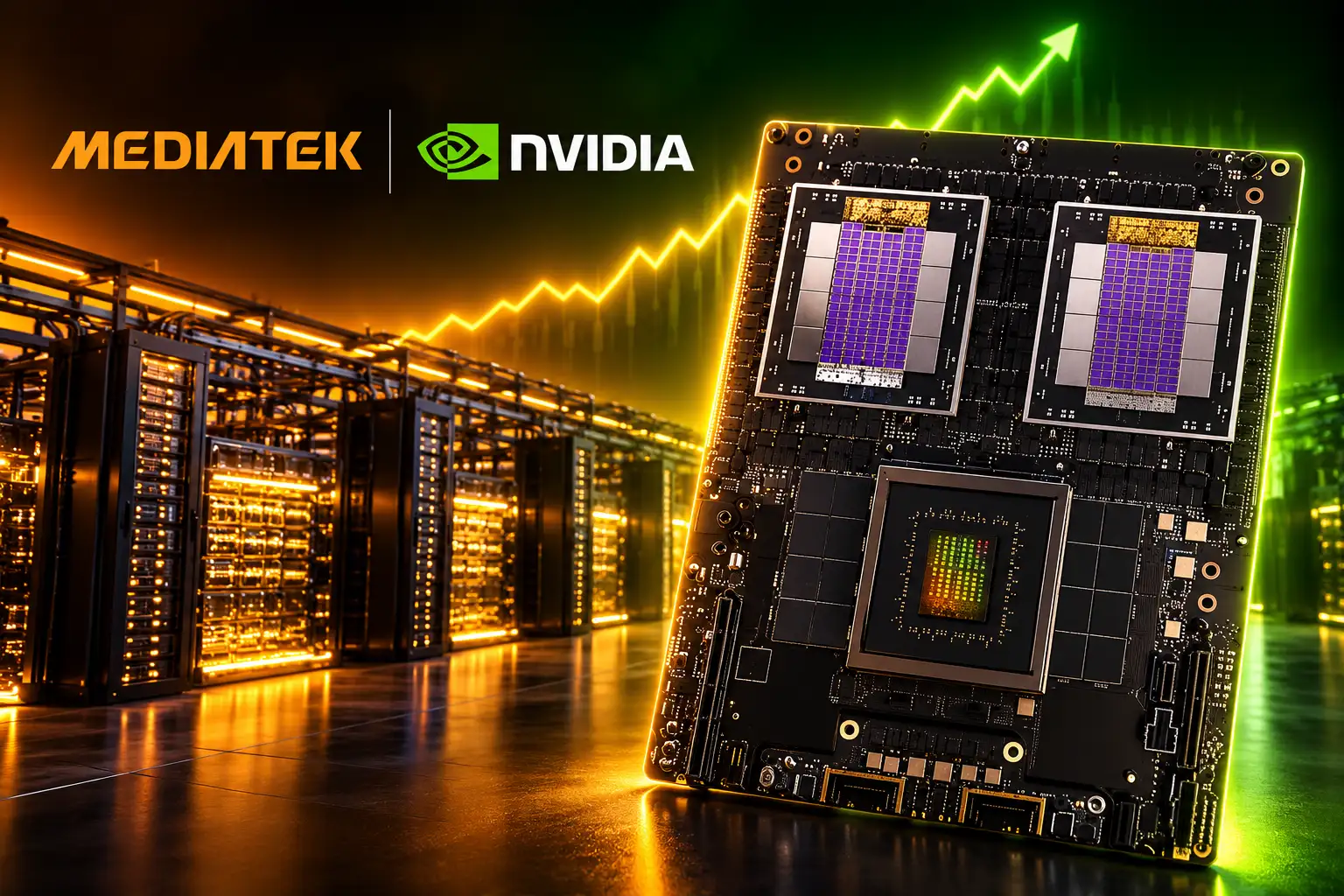
Nvidia bought $3.5 billion of MediaTek convertible bonds so custom AI chips can plug into NVLink racks instead of leaving Nvidia’s factories.

Nvidia bought $3.5 billion of MediaTek convertible bonds on Monday so the Taiwanese chip designer will put customer-built AI processors on NVLink Fusion. The notes pay no coupon and convert at a 15 percent premium to MediaTek’s August 31 close. Cloud companies have been designing their own accelerators to lean less on Nvidia GPUs, and this check gives those chips a finished path into Nvidia’s rack-scale systems.
MediaTek shares jumped about 10 percent on Tuesday. The same two firms already share PC chips and car cabins, but the new money is aimed at the custom-silicon shop MediaTek is trying to build against Broadcom.
A Zero-Coupon Bond With a 15 Percent Conversion Kicker
Nvidia invested $3.5 billion in convertible bonds from a $3.9 billion overseas issue, about 90 percent of the raise. That is about 3.6 percent of the $96.2 billion Nvidia booked in its latest quarter, small against its cash engine and large against MediaTek’s balance sheet. Alphabet joined the book; neither firm disclosed Google’s parent’s slice.
MediaTek’s filing prices a zero-coupon, five-year note that lists in Singapore on September 8 and matures on September 8, 2031. Holders can convert after three months. Nvidia took 17,500 bonds. If the whole issue turns into stock, dilution is about 1.7 percent.
THE CONVERTIBLE BOND NVIDIA BOUGHT
| Term | Detail |
|---|---|
| Issue size | $3.9 billion overseas convertible |
| Nvidia take | $3.5 billion (17,500 bonds) |
| Coupon | 0 percent |
| Tenor | 5 years, matures September 8, 2031 |
| Conversion price | NT$4,513.75, a 15 percent premium to the NT$3,925 close on August 31, 2026 |
| Listing | Singapore Exchange, September 8, 2026 |
| Dilution if converted | about 1.7 percent of shares |
MediaTek told the Taiwan market the raise funds foreign-currency materials and a long-term tie-up, not a related-party rescue. Nvidia gets no interest unless it converts, and it gets equity upside if MediaTek’s data-center line works. That is a call option on the ASIC wave, struck 15 percent above Monday’s close, with capped downside if the shares stall.
Hyperscalers Are Building Chips to Need Nvidia Less
Amazon, Google, Microsoft, OpenAI, and Anthropic have all spent the past two years putting money into chips they own, so training and inference do not sit entirely on Nvidia GPUs. Custom parts cut bill-of-materials cost on a few huge workloads. They also let a cloud firm ship a rack that is not a clone of everyone else’s.
Nvidia cannot stop that work, and it has stopped trying to pretend otherwise. Last week Amazon said it would deploy an additional 2 million Nvidia GPUs and use Nvidia’s interconnect with its in-house processors. Dion Harris, Nvidia’s senior director of HPC and AI hyperscale infrastructure, told reporters the company is an AI infrastructure firm and moved past selling only compute chips years ago.
The second move is the one that matters for MediaTek. If a customer replaces some Nvidia GPUs with its own XPU, Nvidia still wants that XPU talking over NVLink, sitting in an MGX rack, and using Nvidia’s memory and networking kit. Building the accelerator is the prestige job. Qualifying the scale-up fabric, the trays, the cooling, and the plant software is the part that slips schedules.
A custom AI chip is no longer a clean exit. The path that ships on time is to plug the new silicon into a rack Nvidia already knows how to build, service, and fill with software.
What NVLink Fusion Attaches to the Rack
NVLink Fusion is the productized version of that idea. Nvidia’s August 24 technical note says sixth-generation NVLink spans a 72-XPU domain with 3x lower latency than Ethernet alternatives and a 10x higher packet rate. NVLink-C2C, the chip-to-chip link, is rated at up to 6 times the energy efficiency of a PCIe interface.
MediaTek will sell that stack as a design base. Customers can bring an XPU architecture to MediaTek, then take connectivity, memory, packaging, and power as a prequalified kit instead of inventing a factory around a new die.
We’re excited to expand our work with @MediaTek. 🤝
AI factories will be built around differentiated compute — but custom silicon needs a path from chip design to production-scale systems. With MediaTek adopting NVIDIA NVLink Fusion, customers can focus on what makes their XPUs… https://t.co/u7nU5fPyO6
— NVIDIA (@nvidia) August 31, 2026
WHAT COMES WITH NVLINK FUSION
- The chiplet: An NVLink Fusion chiplet ties a custom XPU to Nvidia’s scale-up fabric over electrical links or Nvidia photonics.
- The CPU link: NVLink-C2C connects those XPUs to Nvidia CPUs and other compatible processors at high bandwidth.
- The memory: NVHBM puts customized high-bandwidth memory next to the die so more silicon can go to compute.
- The rack: Partners can reuse the MGX rack recipe, including the supply chain used for Vera Rubin NVL72 systems.
Vince Hu, MediaTek’s corporate senior vice president for data center and computing, put the scheduling trick in one line.
The value of the NVLink Fusion program is customers can deploy their rack-level solution with the NVIDIA GPU, and then they can decouple the development of their XPU and put it at a different pace.
Vince Hu, corporate senior vice president, MediaTek, on Nvidia’s NVLink Fusion briefing
CC Lee, a senior hardware development manager at Annapurna Labs, Amazon’s chip group, said Fusion lets a team use a proven NVL72 rack design and more than one supplier. That is the pitch to a cloud builder that has already poured concrete: freeze the hall, swap the silicon later.
The open question is ugly and practical. When a mixed rack fails, someone has to own firmware, telemetry, and the blame. Fusion shortens time to market. It does not magically assign who debugs a custom XPU at 3 a.m.
$2 Billion This Year, $80 Billion in the Hunt
MediaTek is not a charity case Nvidia is towing into the data center. On the July 31 earnings call, CEO Rick Tsai said a first AI accelerator ASIC for a major U.S. cloud customer is due to start production in the fourth quarter, and he now expects data center revenue to exceed $2 billion in 2026. He raised the 2027 serviceable market to $80 billion and the share target to 15 to 20 percent, from 10 to 15 percent a quarter earlier. A second ASIC is aimed at high-volume production in 2028.
A 15 to 20 percent slice of that $80 billion market would be $12 billion to $16 billion, a long jump from this year’s run rate. The board had already approved a $5 billion financing budget on July 31 to support the data-center push. The convertible is the first big draw on that mandate. Mobile chips, still the company’s public identity, fell 20 percent year over year in the second quarter as phone demand wobbled under higher component costs.
MEDIATEK’S DATA CENTER TARGETS
- 2026 sales: More than $2 billion from data-center chips.
- 2027 market: An $80 billion serviceable custom-chip market, by MediaTek’s own figure.
- Share aim: 15 to 20 percent of that market, which would be $12 billion to $16 billion.
- Tape-out calendar: First ASIC in the fourth quarter of 2026, second ASIC in volume in 2028.
Broadcom still holds the fat custom-chip accounts, with Marvell in second. MediaTek is trying to become the other shop a hyperscaler can call when it wants a die designed, packaged, and stood up without waiting in Broadcom’s queue. Nvidia’s money does not buy those accounts. It makes MediaTek’s pitch easier: we will design your XPU, and it will drop into an Nvidia factory.
That is also the squeeze on independence. A cloud firm that wanted a full stack of its own now gets a faster chip and a slower escape.
Huang Calls the Deal a Decade of Work
Investors have a name for Nvidia writing checks to firms that then buy more Nvidia gear. They call it circular finance. Jensen Huang, Nvidia’s founder and CEO, was asked that question on Bloomberg Television the day the deal landed.
This is not circular because obviously they do their own business and we do our own business. MediaTek’s already incredibly profitable, incredibly successful. They are the world’s best SOC maker. They make more SOCs than any company in the world. The roadmap that we’re executing on right now is not one or two years. It’s a decade long.
Jensen Huang, founder and CEO of Nvidia, on Bloomberg Television
Joe Tigay, portfolio manager at the Rational Equity Armor Fund, drew a thinner line. “Nvidia is financing MediaTek so MediaTek can develop products that extend Nvidia’s architecture,” he said. He added that this is less circular than funding a customer, and that Nvidia is still using its balance sheet to speed a partner network.
Both can be true at once. MediaTek sells phones, TVs, cars, and now ASICs. It does not exist to absorb leftover GPU supply. The convertible still ties Nvidia’s equity upside to a design house whose new products are built to live on NVLink. Alphabet’s quiet order in the same book is the one fact that does not fit a closed loop, because Google’s parent does not need MediaTek to purchase more Nvidia parts for the trade to work.
Holiday Laptops, Then Software-Defined Cars
The Fusion pact sits on work the two companies have already shipped. MediaTek co-designed the GB10 Grace Blackwell Superchip inside Nvidia’s DGX Spark desk system, pairing a Blackwell GPU with a Grace CPU over NVLink-C2C. MediaTek’s launch note put 128GB of unified memory and up to 1 PFLOP of AI performance on that board, enough for local models up to 200 billion parameters.
In June they extended the same pairing into RTX Spark, a Windows PC chip for agentic software, creation, and games. Tsai told investors on July 31 those machines should be on shelves for the holiday season. The new note locks in more generations of both Spark lines, with Nvidia on the GPU and MediaTek on the power-efficient SoC.
Cars are the older thread. In May 2023 the firms said they would put Nvidia GPU chiplets and Drive software on MediaTek’s Dimensity Auto platforms, with first products then aimed at late 2025. Monday’s statement keeps that work going for software-defined vehicles, with Dimensity Auto cockpits using Nvidia RTX graphics beside Drive AGX.
HOW THE TWO CHIPMAKERS GOT HERE
- May 2023: MediaTek and Nvidia announce Dimensity Auto platforms that integrate Nvidia AI and RTX graphics and can sit beside Drive AGX.
- October 2025: DGX Spark ships with the GB10 superchip co-designed by MediaTek, 128GB of memory, and up to 1 PFLOP.
- June 2026: The firms introduce RTX Spark for Windows PCs built around personal agents.
- July 31, 2026: Tsai raises data-center targets and the board approves a $5 billion financing budget; holiday RTX Spark laptops are on the calendar.
- August 24, 2026: Nvidia publishes the NVLink Fusion factory pitch, with MediaTek already in the partner set.
- August 31, 2026: Nvidia takes $3.5 billion of MediaTek convertibles and MediaTek adopts Fusion for customer XPUs.
- September 8, 2026: The notes are due to list on the Singapore Exchange.
Huang told Ed Ludlow the Spark processor is also the base of a new Windows PC Nvidia is building with Microsoft for the age of agents. That consumer line does not need a $3.5 billion bond. It does need MediaTek to keep showing up for the next several SoC turns, which is what a decade-long map is for.
UALink Still Competes for the Same Rack
Fusion is not the only way to wire a rack. Scale-up Ethernet is the conservative path, using parts every operator already understands. UALink is the open alternative, with AMD among the firms pushing it into rack-scale systems. Nvidia is paying to make Fusion the easy one: prevalidated, already cooled, already in the cable plan, already in the software.
MediaTek becomes the design house that makes that easy path look like independence. Customers still choose their XPU. They choose it into an Nvidia hall. Broadcom can keep the accounts it already owns. Qualcomm still fights MediaTek in phones and will feel the PC and car overlap. The convertible lists in six days. Conversion opens three months after that, which is when Nvidia’s paper claim on MediaTek stock becomes a live one.
Disclaimer: This article is news reporting and analysis of a corporate bond purchase and chip partnership. It is for information only and is not investment advice, a recommendation to buy or sell Nvidia, MediaTek, Alphabet, Broadcom, or any other security, and it is not legal advice on convertible bonds or securities law. Readers should consult a licensed financial adviser or securities professional before acting on conversion terms, dilution, share-price moves, or partnership claims. Figures and schedules reflect company statements and Taiwan market filings as of September 2, 2026, and bond terms, listings, product dates, and revenue targets can change.

The $2,599 Surface Laptop Ultra Hides a $5,900 Machine

Universities Face a $70,000 Bill for Each OPT Nod

Contactless eGates Let British Faces Open UK Borders

Securitize Joins LG CNS to Wire Korea’s Token Rails

Meta Wrapped Muse in a Toy and Handed It the Keys

Nvidia’s $3.5 Billion MediaTek Deal Keeps Custom Chips Close

Pelacarsen Miss Hands the Lp(a) Bet to Amgen

Pittsburgh Keeps Four Quarterbacks and Still Lacks a Successor

Tony Romo’s OWI Plea Follows Him Into Every Car

Shopify’s AI Push Pays Off Through Payments Mix
-
 NEWS1 month ago
Pelacarsen Miss Hands the Lp(a) Bet to Amgen
-
 NEWS2 months ago
Pittsburgh Keeps Four Quarterbacks and Still Lacks a Successor
-
 NEWS2 months ago
Tony Romo’s OWI Plea Follows Him Into Every Car
-
 NEWS1 month ago
Shopify’s AI Push Pays Off Through Payments Mix
-
 NEWS1 month ago
POET Takes CPO Lasers to Shenzhen’s Optics Floor
-

 NEWS1 month ago
Health-ISAC Warns ShinyHunters Is Walking Through Hospital Logins
-

 NEWS1 month ago
Australia’s Feed Prompts Leave the Algorithm Switched On
-

 BUSINESS1 month ago
Chris Larsen Wants the Clarity Act, Ethics Fight and All