
NEWS
POET Takes CPO Lasers to Shenzhen’s Optics Floor
POET is pitching high-power CPO lasers and 1.6T engines at CIOE 2026, a product class its Malaysian factories have yet to fill at volume.

POET Technologies is sending high-power, multi-wavelength lasers for co-packaged optics to CIOE 2026 in Shenzhen. Dr. Mo Jinyu, senior vice president of global product development, speaks on September 8 at IFOC on those light sources for CPO, AI and machine-learning links. The company then opens Booth 13A35 in Hall 13 from September 9 to 11.
The slot is not a first look at a lab demo. It is a production pitch for engines and external lasers that still have to clear customer qualification on a Malaysian line.
Hall 13 Is Selling a Production Story
On September 4 the Toronto-based designer said it would exhibit at CIOE 2026, the 27th China International Optoelectronic Expo at Shenzhen World Exhibition and Convention Center. IFOC runs September 7 to 8 and feeds the same crowd. The expo’s own listing puts more than 4,000 exhibitors from more than 30 countries in the halls. POET’s booth is its fourth at the show.
NEWS: $POET to Exhibit at CIOE 2026
Also, Senior Vice President, Global Product Development, Dr. Mo Jinyu, will speak to delegates at the 2026 Infostone Optical Communication and Market Technology Conference (IFOC) about “High Power and Multi-wavelength Laser Light Sources for…
— POET Technologies (@POETtech) September 4, 2026
Chairman and CEO Dr. Suresh Venkatesan framed the week around factory progress, not a new architecture slide.
For 2026, we expect to share details of our continued manufacturing progress and the reasons why a growing number of industry leaders see POET’s wafer-level chip-scale packaging technology as a viable solution to their needs for low-cost, high-power optical interconnects.
Dr. Suresh Venkatesan, Chairman and CEO, POET Technologies, September 4, 2026 release
The hardware mix on the table has shifted from a sample tray to a family that the company says is moving into qualification builds. A CIOE product preview lists the Teralight 1.6T transmit engine with 200G-per-channel electro-absorption modulated lasers, eight channels using four Mitsubishi Electric 2×200G EML chips. Receive engines pair 200G-per-channel transimpedance amplifiers from Semtech in DR8 and 2×FR4 versions already sampled to some customers. Mux and demux sit on the chip, which cuts the extra optics those modules usually carry.
THE HALL 13 PRODUCT STACK
| Product | Job | Where it stands |
|---|---|---|
| POET Infinity | 800G transmit and receive engines (2×FR4, 2×DR4, DR8) | Production order of more than $5 million, shipments aimed at H2 2026 |
| POET Teralight | 1.6T engines at 200G per lane | Samples in Q3 2025; production units for customer qualification from H2 2026 |
| POET Blazar | High-power multi-channel hybrid laser for chip-to-chip and CPO | Live at OFC 2026; customer prototypes aimed at H2 2026 |
| POET Starlight | Eight-channel high-power external light source in an ELSFP-style module | Live at OFC 2026 with Blazar |
Teralight samples left the building in the third quarter of 2025. The 2026 ask is different: send production-style units that module houses can qualify. Infinity already has a named production order from a systems integrator, dated October 2025, for 2×FR4 and DR8 transmit engines and matching receive parts. Wafer-level assembly is the commercial claim, because a conventional optical engine is still put together more like a watch than a chip.
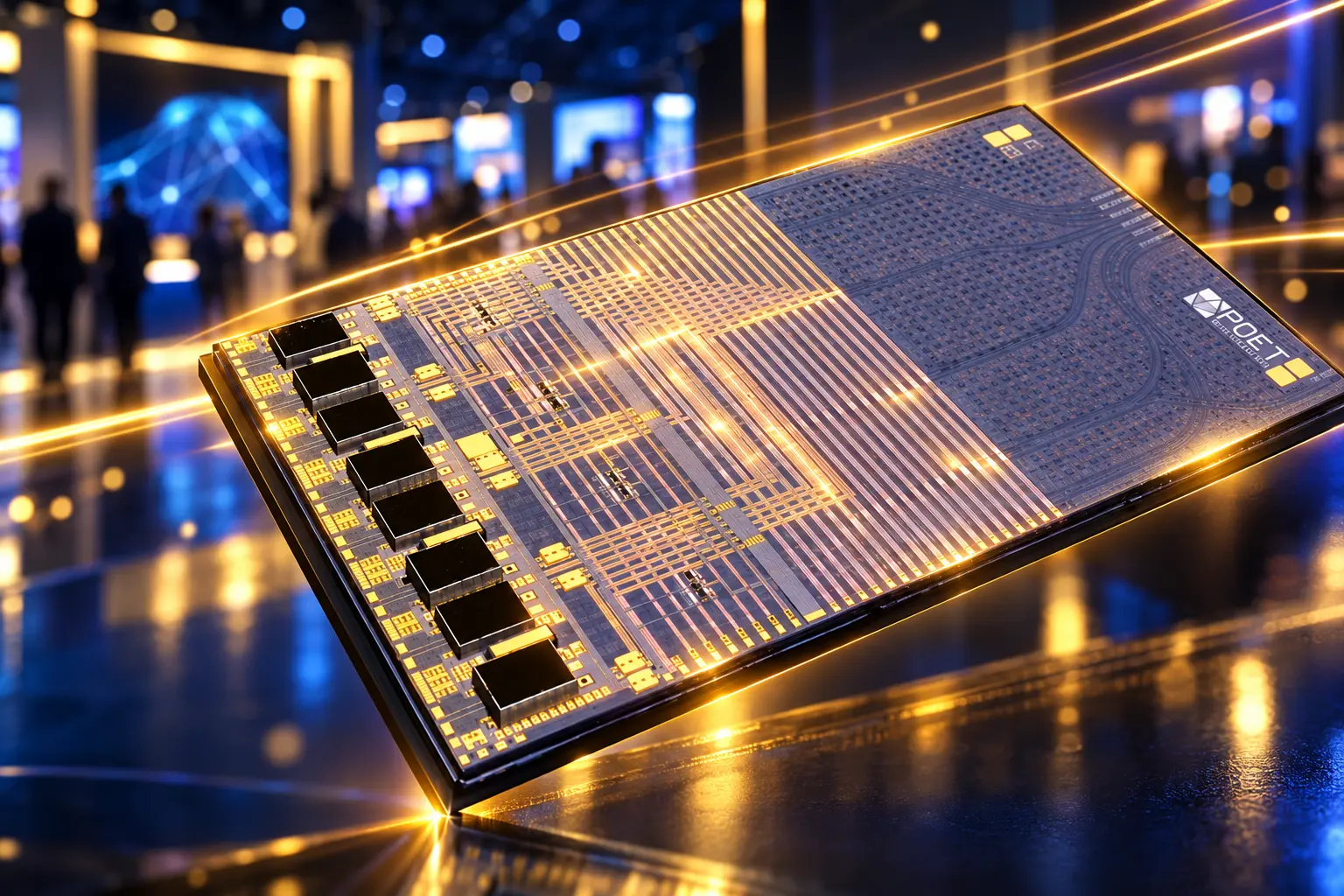
Why Co-Packaged Optics Still Need a Separate Laser
Mo’s IFOC title is the tell. She is not giving a general interposer talk. She is talking about high-power, multi-wavelength laser light sources for CPO, AI and ML interconnects, at 2:50 p.m. local time on September 8.
Co-packaged optics put the photonic engine next to the switch ASIC so the electrical hop gets shorter and the watts per bit fall. Silicon still does a poor job of making light, and a laser that dies inside the package is a nightmare to service. Production CPO designs therefore keep the laser off the ASIC, in a field-replaceable external source. That is the product class POET is pushing with the POET Blazar hybrid laser and Starlight.
NVIDIA already lists co-packaged optics networking switches on its silicon photonics roster, including Spectrum-X Photonics aimed at the second half of 2026. Those systems still need someone to feed them continuous-wave light, at more than one wavelength if the fabric moves to WDM. Blazar is a wafer-level external-cavity laser aimed at that job and at GPU-to-GPU links. Starlight is the eight-channel pack in a pluggable ELSFP-style shell.
The same Optical Interposer substrate is meant to carry 800G, 1.6T and 3.2T without a clean-sheet redesign, which matters because hyperscale qualification can run a year. POET and Quantum Computing Inc. are co-developing 400G-per-lane engines on thin-film lithium niobate for 3.2T CPO. LightCounting has put that 3.2T CPO market at about $12 billion by 2030. Light source work with Sivers Semiconductors is targeted by the end of 2026. That is not a 2026 revenue line. It is the reason a Canadian PIC house is standing in Hall 13 talking about lasers instead of transceivers.
LITEON, Lumilens and the Module Middle
POET does not sell a finished rack switch. It sells the engine that a module maker drops into an 800G or 1.6T pluggable, or the light source a CPO design parks on the front panel. The buyers who can turn a booth visit into a purchase order are those houses, plus a handful of systems integrators, not the hyperscaler brand on the hall banner.
THE ORDER BOOK ON THE TABLE
- Infinity 800G: An October 2025 production order of more than $5 million from a leading systems integrator, with shipments targeted for the second half of 2026.
- LITEON modules: A March 2026 joint program on 800G, 1.6T and faster AI modules, with prototypes planned for late 2026 and high-volume output aimed at 2027.
- Lessengers 1.6T: A March 2026 expansion to co-deliver a 1.6T 2×DR4 transceiver, with samples targeted for the third quarter of 2026.
- Lumilens EOI engines: A May 2026 supply pact with an initial purchase order of $50 million, inside a framework that could exceed $500 million over five years if development and qualification hold.
- QCi 3.2T: A thin-film lithium niobate engine program aimed at CPO, with joint work targeted through the second half of 2026.
LightCounting forecasts more than 125 million 1.6T DR8 and 2×DR4 transceivers will ship from 2027 to 2031. That is the volume ramp POET is trying to enter through Lessengers and LITEON rather than by becoming a transceiver brand. Lumilens is the largest disclosed ticket, and it is also the most conditional: engineering samples are expected in late 2026, with a production ramp tied to hyperscaler deployments in 2027. Revenue from that order depends on module development, qualification and factory scale. The live question around the IFOC slot is still who Lumilens is actually supplying, and how far those engines have moved through a customer lab.
Penang Builds What Shenzhen Will See
POET still lists operations in Singapore, Penang and Shenzhen. The factory story is no longer Xiamen. Super Photonics Xiamen, the old joint venture with Sanan IC, was wound up after the company decided it could not get full operational control and wanted less geopolitical exposure in China. Production gear moved to two Malaysian contractors.
THE SHIFT OFF THE XIAMEN FLOOR
- March 2021: Super Photonics Xiamen is formed as the volume path for Optical Interposer engines.
- December 31, 2025: POET takes the remaining Sanan IC stake, records the wind-up, and treats the Xiamen operation as closed.
- H1 2026: Globetronics Manufacturing and NationGate Solution in Penang hold the assembly and test work after the equipment transfer.
- H2 2026: Management says the optical-engine production ramp stays on schedule, starting with qualification shipments.
- 2027: Partner cleanrooms are meant to take the volume that 1.6T module programs would need if those designs lock in.
Globetronics runs an approximately 10,000-square-foot cleanroom in Malaysia with stated annual capacity for one million optical engines, focused on 800G assembly and test. NationGate has a comparable room for light sources. At the June 26, 2026 annual meeting, Venkatesan put headcount at about 115 and rising. The 2026 shipment target is more than 30,000 optical engines across high-speed and high-power lines, which is 3% of that stated annual engine capacity. Shenzhen remains a sales and engineering door into the supply chain that stuffs most of the world’s transceivers. Penang is where a failed bond yield would show up first.
Six Quarters of Growth on a Thin Base
The financial print behind the booth is a development-stage company with a large cash pile and a still-tiny sales line. Unaudited results for the quarter ended June 30, 2026 show NRE and product revenue of $569,925, up 13% from $503,389 in the first quarter and 112% from $268,469 a year earlier. That was the sixth straight quarter of sequential growth. Net loss narrowed to $11.3 million, or $0.07 a share, from $12.3 million in the first quarter.
Q2 2026 IN FOUR LINES
- H1 revenue: $1,073,314, almost matching the $1,074,865 booked for all of 2025.
- Cash pile: $796.3 million in cash and short-term investments at June 30, after a $400 million financing in May and $150 million in January.
- H1 loss: $23.7 million, against a 2025 full-year net loss of $63.0 million.
- Cash burn: $21.1 million used in operations in the first half, partly offset by $8.3 million of interest income on the stack.
At the June meeting Venkatesan said POET had raised $830 million across equity rounds in the prior twelve months. That raise, not product profit, is what funds the Malaysian rooms, the light-source work and the Lumilens scale-up. Q2 also named Dr. Sandeep Kumar as chief operating officer, a hire that only makes sense if the story is now a factory problem. A $50 million purchase order would dwarf any quarter POET has printed. It is not revenue until engines ship, get accepted and get paid.
The Qualification Queue Still Decides It
Design wins, repeat orders and a cost that holds at wafer scale are still the gates. A booth cannot open them. Infinity has to ship against that more-than-$5 million order in the second half of 2026. Teralight has to move from 2025 samples to production-style units that survive a module maker’s lab. Lumilens samples are due late this year, with 2027 as the hyperscaler-aligned ramp. Blazar’s own commercial map still runs through prototypes now, design-in in 2027 and a later revenue climb.
WHAT WE KNOW
- The calendar: Mo’s IFOC talk is set for 2:50 p.m. on September 8; CIOE runs September 9 to 11 at Booth 13A35.
- The cash: $796.3 million on the June 30 balance sheet, with little debt of note in the company’s own description.
- The disclosed tickets: Infinity above $5 million and Lumilens at $50 million up front, the second one milestone-gated.
WHAT IS UNCONFIRMED
- End customers: Which hyperscale programs sit behind Lumilens, LITEON and the unnamed Infinity buyer.
- Yield: Whether Penang can hold flip-chip and laser attach yields once monthly output leaves sample volumes.
- Conversion: Whether the $50 million Lumilens order and the 30,000-engine 2026 target both land as recognized sales.
Hall 13 will be full of module houses that already know how to put 800G in a cage. The harder test is whether a wafer-level engine and a multi-wavelength CPO laser can pass the same qualification grind those houses already run on discrete parts. Mo can describe the light source at 2:50 p.m. She cannot, from that lectern, say which hyperscale line it has cleared.
Disclaimer: This article is news reporting and analysis of POET Technologies’ public product, conference and financial disclosures. It is informational only and is not investment advice, a recommendation to buy or sell POET or any other security, or a forecast of future revenue, margins or share price. Readers should consult a licensed financial adviser or other qualified investment professional who can consider their own objectives and risk limits before acting on any ticker mentioned here. Figures, order values, capacity claims and partnership status reflect company filings and statements as dated in the piece and can change with later results, qualification outcomes or contract amendments.

The $2,599 Surface Laptop Ultra Hides a $5,900 Machine

Universities Face a $70,000 Bill for Each OPT Nod

Contactless eGates Let British Faces Open UK Borders

Securitize Joins LG CNS to Wire Korea’s Token Rails

Meta Wrapped Muse in a Toy and Handed It the Keys

Nvidia’s $3.5 Billion MediaTek Deal Keeps Custom Chips Close

Pittsburgh Keeps Four Quarterbacks and Still Lacks a Successor

Pelacarsen Miss Hands the Lp(a) Bet to Amgen

Tony Romo’s OWI Plea Follows Him Into Every Car

Shopify’s AI Push Pays Off Through Payments Mix
-
 NEWS2 months ago
Nvidia’s $3.5 Billion MediaTek Deal Keeps Custom Chips Close
-
 NEWS2 months ago
Pittsburgh Keeps Four Quarterbacks and Still Lacks a Successor
-
 NEWS1 month ago
Pelacarsen Miss Hands the Lp(a) Bet to Amgen
-
 NEWS2 months ago
Tony Romo’s OWI Plea Follows Him Into Every Car
-
 NEWS1 month ago
Shopify’s AI Push Pays Off Through Payments Mix
-

 NEWS1 month ago
Health-ISAC Warns ShinyHunters Is Walking Through Hospital Logins
-

 NEWS1 month ago
Australia’s Feed Prompts Leave the Algorithm Switched On
-

 BUSINESS1 month ago
Chris Larsen Wants the Clarity Act, Ethics Fight and All