
NEWS
Taiwan’s First F-16V Jets Arrive Three Years Late
Two F-16V Block 70 fighters reached Taitung a week after Trump hosted Xi, three years late, with 64 jets and a $14 billion package still waiting.

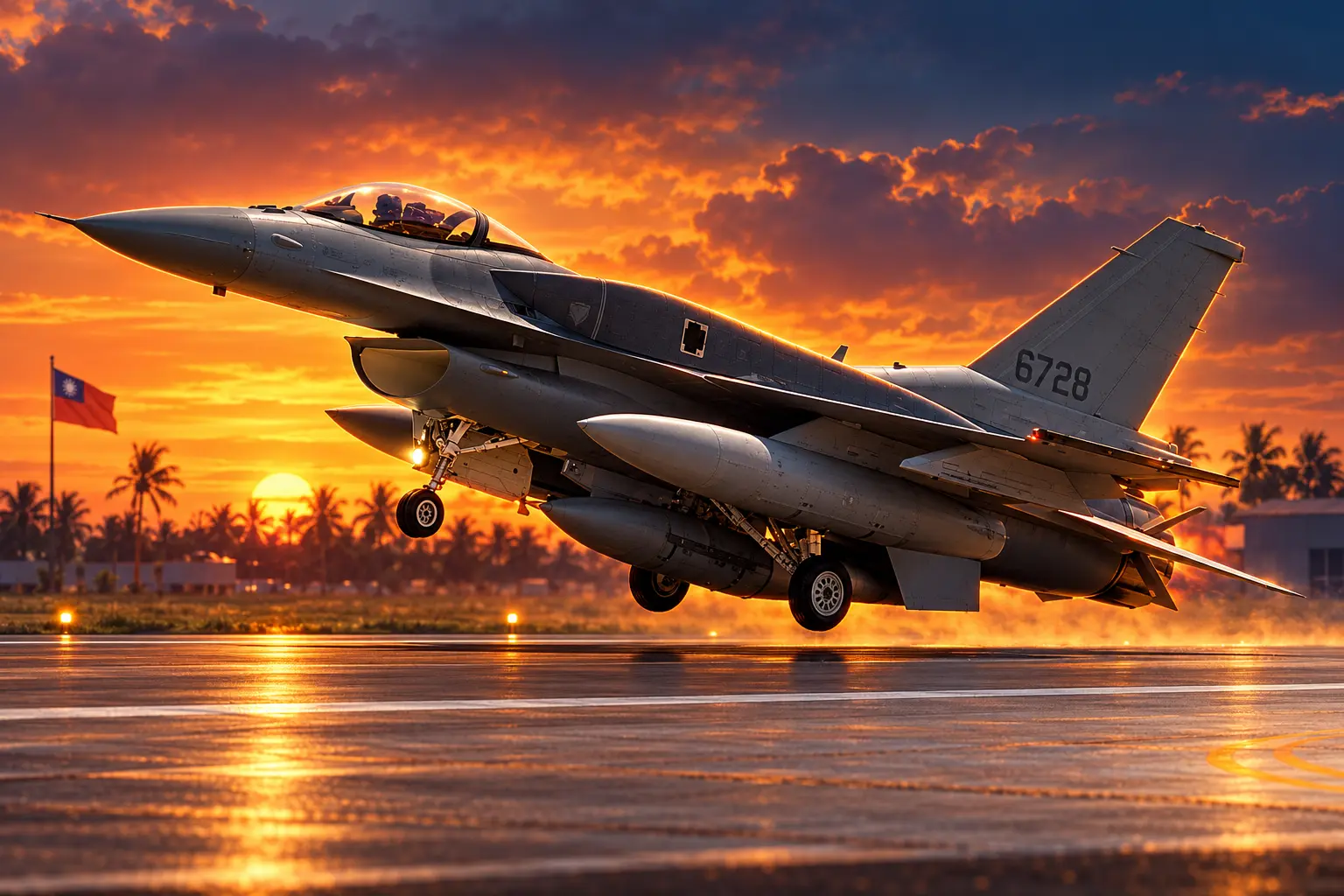
Two Lockheed Martin F-16V Block 70 fighters, tail numbers 6727 and 6728, landed at Chihhang Air Base in Taitung at noon on October 2, 2026. They are the first of 66 jets from an $8 billion sale approved in August 2019.
The pair arrived a week after President Donald Trump hosted Chinese President Xi Jinping in Washington, and three years after deliveries were supposed to begin.
Two Vipers Touch Down Three Years Late
The jets are single-seat airframes from Taiwan’s Peace Phoenix Soaring buy, a program the air force funded at NT$247.2 billion (about $8 billion) between 2020 and 2026. Washington’s original plan was to start handing over the fleet in 2023 and finish by the end of 2026. Production-line moves, supply-chain breaks, and software trouble pushed that calendar out.
Defense Minister Wellington Koo told reporters at the Legislative Yuan that there will be more than two jets delivered this year, with later dates set jointly with the United States. The Air Force Command said some of the remaining 63 aircraft have already reached the delivery stage. The mix on order is 56 single-seat jets and 10 two-seaters.
THE FIRST PAIR ON THE GROUND
- The airframes: Tail numbers 6727 and 6728, both single-seat Block 70s built in Greenville, South Carolina.
- The clock: Approved on August 20, 2019, first wheels on Taiwanese concrete on October 2, 2026, seven years later.
- The slip: Deliveries were meant to start in 2023, which puts this arrival about three years behind that start date.
- The paperwork: The jets remain US property until a joint handover and acceptance checks are finished.
Two new fighters do not reset the air balance across the Strait. They do prove the 2019 contract can still move after Trump sat with Xi, which is a narrower, and more political, result than the landing photos suggest.
The Hawaii Stop That Lasted Six Weeks
Lockheed Martin rolled the pair out of Greenville on August 17, 2026. They reached Hawaii on August 21 and had been due in Taiwan by late August. They were still in Hawaii into late September, with no public explanation, while Trump prepared to host Xi in Washington.
Flight-tracking logs then showed the jets leaving Honolulu for Guam on September 30 on a tanker-supported Pacific ferry, the last hop before Taitung. The stop in the islands lasted about six weeks. Weather and possible mechanical trouble had already been cited around an earlier Guam attempt in late August, so the long Hawaii hold stacked a political calendar on top of a ferry that was already slipping.
THE FERRY TO TAITUNG
- August 17, 2026: The two jets leave Lockheed Martin’s Greenville plant.
- August 21, 2026: They arrive in Hawaii, the first major Pacific stop.
- Late August 2026: Taiwan had expected them on the island by this window; they do not appear.
- September 30, 2026: They depart Honolulu for Guam after sitting through Trump’s meeting with Xi.
- October 2, 2026: They land at Chihhang around noon local time (04:00 GMT).
Beijing has asked Washington, repeatedly, to stop arming the island. The United States says policy is unchanged. Holding two finished fighters in Hawaii through a summit is how those two sentences can both be true on the same day.
What Taiwan Is Getting in the Block 70
The new jets are not a stealth design. They are the current production F-16, built around Northrop Grumman’s APG-83 AESA radar, which Lockheed Martin says draws hardware and software commonality with F-22 and F-35 radars. Su Tzu-yun, a senior analyst at the Institute for National Defense and Security Research, has said that radar was built to find small-signature targets and can improve the F-16V’s odds of spotting PLA stealth types such as the J-20 and J-35.
Power comes from a General Electric F110-GE-129 turbofan rated at up to 29,500 pounds of thrust. Conformal fuel tanks add range without eating wing stations. The jet has 11 external hardpoints and can carry AIM-9X and AIM-120D air-to-air missiles, AGM-88 anti-radiation missiles, AGM-154C glide weapons, JDAM kits, and Harpoon anti-ship missiles. Pilots get the Joint Helmet Mounted Cueing System II, so they can cue sensors by looking at a target.
THE BLOCK 70 KIT
- The radar: AN/APG-83 active electronically scanned array for longer-range search and better resistance to jamming.
- The airframe: A new structure with a 12,000-hour structural service life, more than 50 percent beyond earlier production F-16s.
- The tanks: Conformal fuel tanks that free the wings for weapons instead of extra fuel.
- The suite: L3Harris AN/ALQ-254(V)1 Viper Shield electronic warfare, which Koo said was still in testing on schedule; the first pair landed without that suite installed.
An F-16V without Viper Shield is a jet that can fly and train. It is not yet the airplane on the brochure, especially against a Chinese force that already fields jammers and long-range missiles as a package.
An $8 Billion Order Is Still in South Carolina
On August 20, 2019, the State Department cleared a possible sale to the Taipei Economic and Cultural Representative Office of 66 F-16C/D Block 70 aircraft, 75 F110 engines (including 9 spares), 75 Link-16 sets, 75 APG-83 radars, and related support, at an estimated $8 billion. That notification, transmittal 19-50, is the legal spine of Friday’s landing.
George Mason University’s Taiwan Security Monitor still counted an August 2026 $29.72 billion arms-sale backlog of cases notified to Congress but not fully delivered. The F-16C/D Block 70 line alone was $8,000 million, or 26.92 percent of that total. Traditional platforms as a group were $12,927 million. The F-16 case was too large for the tracker to mark as “in delivery” until the airframes were actually on the island.
WHAT HAS MOVED BESIDE THE JETS
| Case | Value | Status as of late 2026 |
|---|---|---|
| F-16C/D Block 70 | $8 billion | First two in Taitung; Air Force says 63 still in the US pipeline |
| F-16 munitions (HARM, AMRAAM) | $619 million | All 100 AGM-88 HARMs reported deployed; AIM-120C-8s arriving in batches toward 200 |
| AIM-9X Block II | $86 million | Initial batch in country from a buy of about 140 missiles |
| AGM-154C JSOW | $186 million | Delivery slipped to 2027-2028; notified in June 2017 |
Missiles for the existing F-16V fleet have been moving even while the new airframes sat in South Carolina. The Joint Standoff Weapon, by contrast, will have spent close to a decade in the pipeline before the first round lands, if that 2027-2028 window holds. Hardware without the matching standoff load is a shorter spear than the order form implies.
Taiwan Walked Away From the F-35B
Taipei once chased the F-35B, the short-takeoff variant, then dropped it. Cost and upkeep were part of the reason. So was logistics: Taiwan already flies F-16s, already trains on them, and already repairs them at Aerospace Industrial Development Corp. in Taichung. A new-build Block 70 slots into that base. An F-35 fleet would have meant a second supply chain and a longer wait for a jet Washington has not been willing to release to the island anyway.
The United States has also kept the F-22 and F-35 off the table for Taiwan. The Block 70 is the high end of what Washington will sell, not the high end of what it flies. Once all 66 arrive, they will sit beside 139 F-16A/Bs that finished a Viper upgrade in December 2023, a combined force of 205 aircraft and one of the world’s largest F-16V fleets. Quantity is the bet. Stealth is not.
As of the end of 2025, a military official said Taiwan had taken in more than $70 million in royalties from the F-16V program it helped fund after other customers stepped back. That is a real industrial return. It does not put a fifth-generation fighter on Chihhang’s ramp.
Eastern Taiwan Gets the New Wing First
All 66 new jets are slated for Chihhang with the 7th Tactical Fighter Wing, formed on December 1, 2023, on a field that used to host F-5E/F trainers. The wing is standing up in three phases, with pilots and maintainers already cycling through the United States. Koo called eastern Taiwan an important stronghold for preserving combat power and would not say more about basing.
The east coast faces the open Pacific. Chinese aircraft and ships have used that side of the island in large drills, and the mountain spine gives the air force a little more depth than the west-coast bases that sit closer to the Strait. Putting the new wing there is a dispersal choice as much as a flying one. Taiwan’s original F-16A/Bs first arrived in 1997. This is the first new-build fighter batch in nearly 30 years.
This is an important milestone in strengthening Taiwan’s air defense capabilities. It also demonstrates our resolve to bolster self-defense and ensure peace through strength.
Lai Ching-te, President of Taiwan, social media post, October 2, 2026
Lai wrote that investing in defense raises the cost of an invasion and lowers the risk of a misread. The Air Force Command said it will run the planned conversion training and bring the jets online in phases. A milestone is not a squadron. Conversion, weapons clearance, and the missing electronic-warfare kit still sit between the landing and a combat-coded jet.
Trump Holds the Next Arms Tranche After Beijing
The 1979 Taiwan Relations Act commits the United States to provide arms of a defensive character and to make available the defense articles Taiwan needs for a sufficient self-defense. There are no formal diplomatic ties. The law is the channel, and the president is still the throttle.
Trump’s team notified Congress on December 17, 2025, of a new package worth $11 billion, then the largest FMS notification for Taiwan by dollar value, built around HIMARS, M109A7 howitzers, Javelin and TOW missiles, and Altius drones. In May 2026, after meeting Xi in Beijing, Trump said he was holding a separate $14 billion package. That hold was still in place when the two Vipers landed, a week after the two leaders met again in Washington.
Asked about the delivery, a State Department spokesperson said US policy on Taiwan has not changed and remains guided by the Taiwan Relations Act, the three Joint Communiques, and the Six Assurances. The spokesperson added that Washington continues standing with friends and allies across the Indo-Pacific, “that includes Taiwan.”
Those sentences and the Hawaii layover can be read together. The 2019 contract is being honored, slowly. The next large buy is being used as leverage. Koo’s promise of more than two jets by the end of 2026 will be the first test of whether Greenville can turn a ceremony into a flow. The rest of the order is penciled for 2027 and 2028, which is also when the held $14 billion package would have to show up if it is ever released.
Until the acceptance papers are signed, the two jets on Chihhang’s concrete are still American property. Taiwan can photograph them. It cannot yet count them as a wing.

The $2,599 Surface Laptop Ultra Hides a $5,900 Machine

Universities Face a $70,000 Bill for Each OPT Nod

Contactless eGates Let British Faces Open UK Borders

Securitize Joins LG CNS to Wire Korea’s Token Rails

Meta Wrapped Muse in a Toy and Handed It the Keys

Pittsburgh Keeps Four Quarterbacks and Still Lacks a Successor

Nvidia’s $3.5 Billion MediaTek Deal Keeps Custom Chips Close

Pelacarsen Miss Hands the Lp(a) Bet to Amgen

Tony Romo’s OWI Plea Follows Him Into Every Car

Shopify’s AI Push Pays Off Through Payments Mix
-
 NEWS2 months ago
Pittsburgh Keeps Four Quarterbacks and Still Lacks a Successor
-
 NEWS2 months ago
Nvidia’s $3.5 Billion MediaTek Deal Keeps Custom Chips Close
-
 NEWS2 months ago
Pelacarsen Miss Hands the Lp(a) Bet to Amgen
-
 NEWS2 months ago
Tony Romo’s OWI Plea Follows Him Into Every Car
-
 NEWS2 months ago
Shopify’s AI Push Pays Off Through Payments Mix
-

 NEWS2 months ago
POET Takes CPO Lasers to Shenzhen’s Optics Floor
-

 NEWS2 months ago
Health-ISAC Warns ShinyHunters Is Walking Through Hospital Logins
-

 NEWS2 months ago
Australia’s Feed Prompts Leave the Algorithm Switched On