
NEWS
Oklahoma’s Ames Crater Leaves the Ordovician Debris Ring
New zircon dates move Oklahoma’s Ames crater to 369.7 million years, off a proposed Earth ring and beside a volcano-tied extinction.

Zircon dates put Oklahoma’s buried Ames crater at 369.7 million years, nearly 100 million years younger than the Ordovician meteor cluster. The University of Texas at Austin team published the uranium-lead results in July 2026 in Meteoritics & Planetary Science.
That shift knocks a 14 to 16 kilometer structure off a proposed Saturn-like debris ring. It also parks the crater beside the Frasnian-Famennian marine die-off, a crisis recent work ties to volcanoes rather than a rock from space.
Fossil Teeth Locked in the Wrong Era
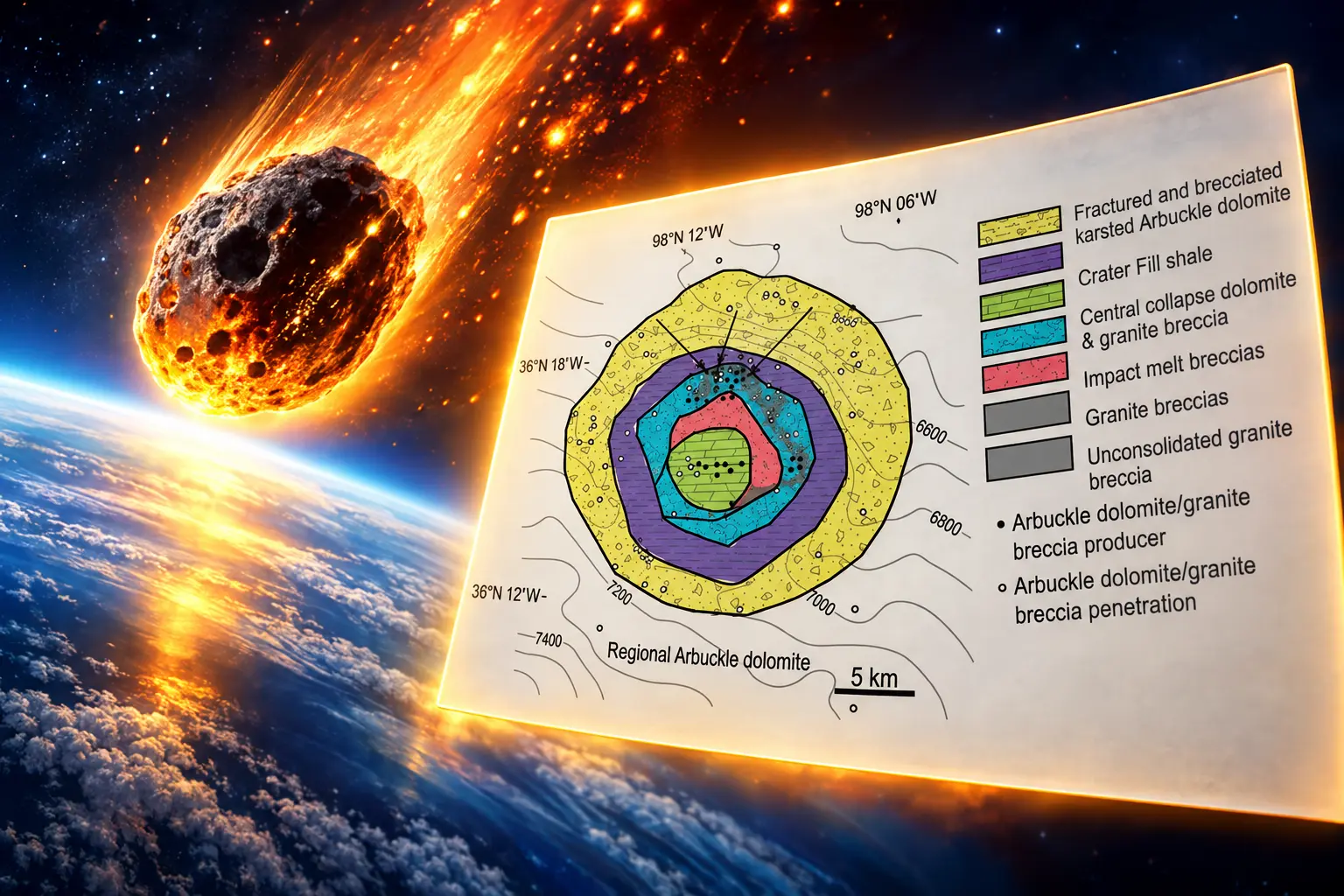
The Ames impact structure sits under the town of Ames in Major County, Oklahoma, southwest of Enid, and does not break the surface. Sediment later buried the bowl under about 3 kilometers of rock, roughly 9,000 feet, so drillers found it before field geologists did.
For years the crater fill was assigned to the Ordovician Meteor Event, a burst of strikes whose ages cluster around 467.5 million years. That assignment came from conodonts, tiny eel-like animals whose tooth-like fossils turned up in the crater rock and belong to Ordovician seas.
Lead author Elizabeth Catlos, an associate professor in UT’s Department of Earth and Planetary Sciences, said those teeth were likely already millions of years old when the meteorite arrived. The blast mixed older beds into the new crater and left the fossils intact, which is a dating trap, not a clock for the collision.
WHY THE TEETH COULD NOT DATE THE BLAST
- The animal, not the hit: A conodont fossil records when that creature lived, not when later rubble swallowed its remains.
- Reworked fill: An impact can churn older seabed into younger crater rock and still preserve the shells and teeth.
- No radio clock: Until this study, Ames had no published uranium-lead age that independently tested the fossil assignment.
Catlos’s Jackson School of Geosciences team now treats that Ordovician tag as inherited debris. The crystals in the melted granite tell a younger story.
A 369.7-Million-Year Signal in Melted Granite
The group dated zircon from the impact-melted part of the basement, using an ion probe and laser ablation on 37 spots. Most grains still remember the original granite-like rock, which gives a Concordia upper intercept of 1401.2 million years, plus or minus 8.1 million.
The youngest cluster is different. Ten of 11 young dates agree, and they share a weighted mean age of 369.7 million years, plus or minus 5.9 million, with an MSWD of 0.71. UT’s September 28, 2026 newsroom note said the work shows a meteorite hit Ames in Late Devonian times, about 370 million years ago, not 467 million years ago.
AGES THAT NO LONGER LINE UP
| Clock | Age | What it records |
|---|---|---|
| Youngest zircon mean | 369.7 million years, plus or minus 5.9 million | Late Devonian heating and new zircon growth |
| Frasnian-Famennian crisis (interval cited in the paper) | 371.8 to 372.4 million years | Major marine die-off |
| Ordovician Meteor Event cluster | about 467.5 million years | The old Ames assignment |
| Basement granodiorite | 1401.2 million years, plus or minus 8.1 million | When the target rock first crystallized |
| Plagioclase argon | about 310.5 million and 250.5 million years | Later heating during oil maturation, not the impact |
Catlos said the younger signal kept appearing no matter which technique they used. The paper treats that 369.7 million year mean as the best maximum age on impact-related zircon growth, which is a strong Late Devonian constraint and still short of a perfect stopwatch for the instant of contact.
To check whether the grains had felt the blast, the team worked with NASA on cathodoluminescence and electron backscatter diffraction images. Most zircons, including the youngest, keep original growth bands and show little deformation. Two grains carry shock textures, including fine cracks with low-angle grain boundaries and strings of tiny zircon cutting across older zoning.
Danny Stockli, dean of the Jackson School and a co-author, said zircon uranium-lead dating is among the most accurate ways to time events this old, and that the crystals can also store the pressure of a strike. “These small crystals allow us to go back in time and learn about the major changes to Earth’s ancient landscapes,” Stockli said. “It would be great to do this for more of the meteor impact sites across the continent so we could get a more accurate timeline for these major events.”
Why Ames No Longer Fits a Saturn-Like Ring
The old Ames age had done extra work. So many North American craters seemed to date from the same Ordovician stretch that some researchers argued Earth once wore a debris ring, with fragments falling in a band around the equator instead of arriving at random from the asteroid belt.
In 2024, Andy Tomkins of Monash University and colleagues reconstructed the paleolatitudes of 21 asteroid impact craters near the equator from that spike. All 21 fell within 30 degrees of the equator, even though about 70 percent of the crust that could preserve a crater sat outside that band. Ames was on that North American list.
THE RING CASE AMES WAS PROPPING UP
- The spike: Extra cratering and L-chondrite dust over a stretch of about 40 million years, starting near 466 million years ago.
- The pattern: All 21 mapped craters sit in an equatorial band at or inside 30 degrees.
- The odds: Tomkins’s group calculated a binomial probability of 4 × 10⁻⁸ that belt-orbit impactors would land that way by chance.
- Ames’s job: A named, drilled, 14 to 16 kilometer North American entry on that list, now removed.
Take Ames off the Ordovician board and the ring idea does not vanish; 20 craters remain. What does change is the quality of the board. Ames had been dated from mixed fossils, and it was one of the larger, better known structures in the set. If a drilled oil crater can be nearly 100 million years off, other members still hanging on fossil ages deserve the same zircon test Stockli wants.
Reefs Collapsed While Volcanoes Were Already Active
The new date lands next to another famous interval. Catlos’s paper places the Frasnian-Famennian crisis, also called the Upper Kellwasser crisis, between 371.8 to 372.4 million years ago. Within the zircon error bar of plus or minus 5.9 million years, Ames overlaps that window.
That overlap is the line now being stretched into a cause. The Late Devonian crisis gutted marine ecosystems and hit reef builders especially hard, and it is one of the big Phanerozoic die-offs. For decades the suspect list has included impacts, climate swings, anoxia, and large igneous provinces.
With this research, we’re basically taking a major pawn out of the Ordovician Meteor Event and dumping it into the Frasnian-Famennian event, and saying, ‘This is where this impact belongs.’
Elizabeth Catlos, associate professor, Department of Earth and Planetary Sciences, University of Texas at Austin
Dumping the pawn does not win the game. Mercury spikes in distant Frasnian sections, plus pulses from the Viluy large igneous province in Siberia, are the working volcanic model in much of the recent literature. Catlos herself framed the dating fight as a choice between a force from space and an interior force such as a series of huge eruptions. Ames now sits on the space-rock side of a debate where volcanoes already have the thicker file.
The paper also notes other North American impact records from the same broad Late Devonian stretch, including Flynn Creek in Tennessee and the Alamo impact deposits in Nevada. A cluster of hits would be a different argument than one Oklahoma crater. None of those ages, Ames included, yet does the work an iridium layer and a global kill bed did for the end-Cretaceous.
Oil Wells That Paid for the Cores
Ames became famous as a petroleum trap long before it became a dating problem. The impact shattered granite and Arbuckle dolomite, then later oil migrated into that broken rock. Independent producer Harold Hamm’s Continental Resources drilled into the buried bowl in 1991, going about 10,000 feet and bringing in a well that first made about 200 barrels a day.
Geologists had long treated impact craters as poor places to hunt oil. The Ames wells reversed that bet and pulled other U.S. craters onto exploration maps. The American Oil & Gas Historical Society, drawing on field tallies assembled for the town museum, reports the structure had yielded 17.4 million barrels of oil by 2007, plus 79.5 billion cubic feet of gas, among the largest of six producing astroblemes in the United States. Recoverable estimates cited there run about 25 million barrels of oil and 100 billion cubic feet of gas.
THE CORES THAT CHANGED THE DATE
- 1991: Continental Resources drills deep into the buried Ames structure and finds oil.
- 2018: Andrew Parisi, then a Jackson School graduate student, collects Ames core from the Oklahoma Geological Survey, separates zircon, and helps date it. He later died.
- July 2026: The uranium-lead study appears in Meteoritics & Planetary Science, with Michael Brookfield, another co-author, also gone before print.
- September 28, 2026: The Jackson School releases the result that Ames belongs in the Late Devonian, not the Ordovician cluster.
Research professor Sean Gulick and professor emeritus Mark Cloos also contributed. The argon dates on plagioclase, far younger than the zircon mean, line up with later heating while hydrocarbons matured in the crater, which is why those numbers stay out of the impact age. The same rock that made a field also stored the crystals that rewrote the field’s origin story.
Overlap With an Extinction Is Not Proof
A 16-kilometer-class crater is a local catastrophe. A mass extinction is a global accounting problem. Matching their ages within a few million years is a permission slip to ask the next question, not an answer to it.
The zircon error still spans several million years on either side of the Frasnian-Famennian boundary. The paper’s own images show that most dated grains, including the young ones, lack classic shock fabrics, so the 369.7 million year signal is interpreted as melt-related growth more than as a textbook shocked-zircon stopwatch. Later faults are a weaker rival explanation, because the structure sits largely apart from Oklahoma’s major fault zones, but that argument still leaves the extinction link unproven.
WHAT WE KNOW
- The old cluster: Ames does not belong to the 467.5 million year Ordovician Meteor Event as dated here.
- The new window: The youngest zircon mean is 369.7 million years, plus or minus 5.9 million, overlapping the 371.8 to 372.4 million year crisis interval the authors cite.
- The method: Two independent mass-spec techniques, plus NASA imaging, reproduce a Late Devonian signal in the melt-bearing granite.
WHAT IS UNCONFIRMED
- A kill shot: No global ejecta layer, iridium spike, or kill-bed tie has been shown for Ames at the Frasnian-Famennian boundary.
- A new Devonian swarm: Flynn Creek, Alamo, and Ames share a broad Late Devonian neighborhood, not a single proven barrage.
- The ring’s collapse: Removing one crater weakens a biostratigraphic brick; it does not, by itself, erase the remaining equatorial list.
The louder problem is the habit of treating a redated hole as a new murder weapon. Timing overlap is cheap in deep time. Cause still has to show up in the rocks that record the deaths.
Frequently Asked Questions
Where Is the Ames Crater, and Can Visitors See It?
It lies under Ames in Major County, Oklahoma, southwest of Enid, and the bowl itself is not a surface landmark because later rock covers it. The town, population 190 as of 2024, dedicated a small 24-hour Ames Astrobleme Museum on August 18, 2007, with outdoor video panels rather than a walkable rim.
How Does Zircon Uranium-Lead Dating Work?
Zircon traps uranium when it grows and shuts out lead, so lead that later appears inside the crystal comes from uranium decay and clocks the grain. A second math path through the Ames data, a discordia lower intercept of 374.9 million years, plus or minus 5.3 million, lands in the same Late Devonian window as the 369.7 million year mean.
Did the Ames Strike Cause the Late Devonian Die-Off?
The dates overlap within error, which is not a demonstrated kill mechanism. A 2018 uranium-lead study of a German ash bed put the boundary at 371.93 to 371.78 million years and found Sweden’s Siljan crater, dated about 377 million years, plus or minus 2 million, too old to be the trigger, while mercury spikes and Viluy volcanism remain the thicker file.
What Was the Ordovician Meteor Event?
It is a roughly 40 million year stretch of extra cratering and meteorite dust in the Middle to Late Ordovician, often tied to breakup of the L-chondrite parent body. Sedimentary rocks record a jump in L-chondrite debris at 465.76 million years, plus or minus 0.30 million, which is the dust spike some teams then link to a temporary debris ring rather than to random hits from the asteroid belt.
The same cores that made an oil field held the crystals that pulled Ames out of a 467.5 million year cluster. Stockli wants that test run on more North American craters before anyone rebuilds a ring, or an extinction, from a fossil date alone.

The $2,599 Surface Laptop Ultra Hides a $5,900 Machine

Universities Face a $70,000 Bill for Each OPT Nod

Contactless eGates Let British Faces Open UK Borders

Securitize Joins LG CNS to Wire Korea’s Token Rails

Meta Wrapped Muse in a Toy and Handed It the Keys

Nvidia’s $3.5 Billion MediaTek Deal Keeps Custom Chips Close

Pittsburgh Keeps Four Quarterbacks and Still Lacks a Successor

Pelacarsen Miss Hands the Lp(a) Bet to Amgen

Tony Romo’s OWI Plea Follows Him Into Every Car

Shopify’s AI Push Pays Off Through Payments Mix
-
 NEWS1 month ago
Nvidia’s $3.5 Billion MediaTek Deal Keeps Custom Chips Close
-
 NEWS1 month ago
Pittsburgh Keeps Four Quarterbacks and Still Lacks a Successor
-
 NEWS1 month ago
Pelacarsen Miss Hands the Lp(a) Bet to Amgen
-
 NEWS1 month ago
Tony Romo’s OWI Plea Follows Him Into Every Car
-
 NEWS1 month ago
Shopify’s AI Push Pays Off Through Payments Mix
-

 NEWS1 month ago
POET Takes CPO Lasers to Shenzhen’s Optics Floor
-

 NEWS1 month ago
Health-ISAC Warns ShinyHunters Is Walking Through Hospital Logins
-

 NEWS1 month ago
Australia’s Feed Prompts Leave the Algorithm Switched On