
BUSINESS
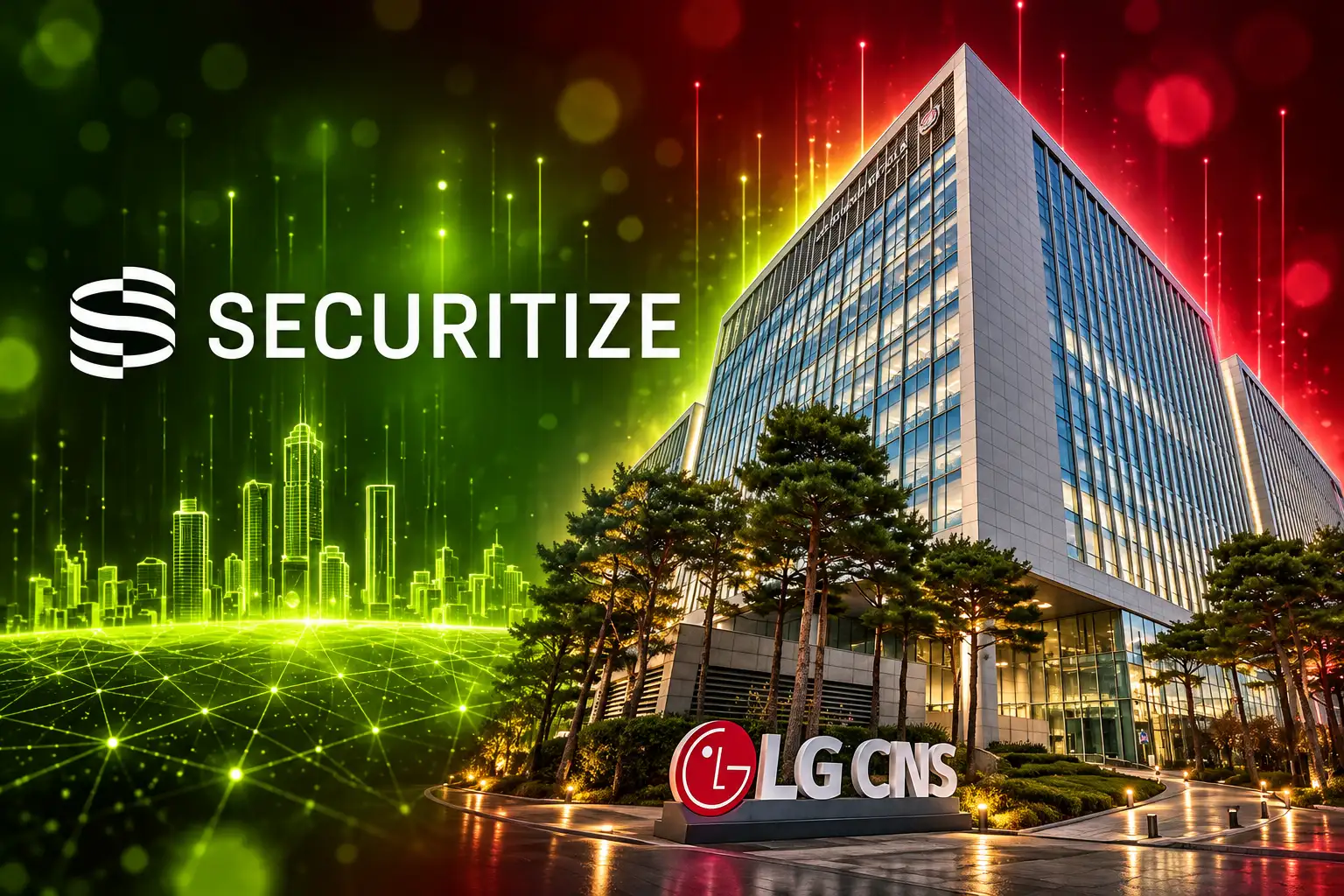
Securitize Joins LG CNS to Wire Korea’s Token Rails
Securitize is one of five vendors on LG CNS’s new KITL stack, timed for Korea’s February 2027 tokenized securities rules, not a named fund launch.

Securitize and LG CNS signed a memorandum of understanding on October 6, 2026 to explore tokenized funds, equities, stablecoins and digital asset systems for Korean financial firms. No fund, bond or coin was named. The same day, LG CNS switched on KITL, a bank-facing blockchain platform already run with seven banks and about 80,000 shoppers, and wrapped five global vendors around it.
The paper from Miami and Seoul reads like a market entry. The working product is software Korean banks can buy before tokenized securities become legal on February 4, 2027.
Securitize Signed Onto a Five-Firm Vendor Stack
Securitize, which trades on the NYSE as SECZ and reported about $5 billion in assets under management as of September 2026, is the U.S. tokenization shop behind funds with managers such as BlackRock, Apollo, KKR, Hamilton Lane, VanEck and BNY. LG CNS is the Korean IT services firm that already sits inside bank computer rooms. Under the memo, Securitize brings regulated issuance kit; LG CNS brings local tech and those bank relationships.
The companies listed three primary areas of collaboration and said any live service still needs Korean law, regulator sign-off, and each firm’s own compliance desk.
WHERE THE MEMO SAYS THE WORK WILL GO
- Market development: Hunt for banks and other firms in Korea and the wider Asia-Pacific that might want tokenized assets, tokenized securities or stablecoins, plus joint education and institutional use cases.
- Technology and product: Study tokenization tools cut to Korean firms and to the country’s changing rulebook.
- Digital asset plumbing: Look at stablecoin rails, digital asset treasury tools and, if law and approvals allow, systems that could link Korean markets to global ones for 24/7 distribution, trading and settlement.
Securitize’s own follow-up said the Korea work would consider funds, equities, bonds and private-market assets inside that rulebook. Carlos Domingo, co-founder and chief executive, called South Korea an important market for the next phase of institutional tokenization and said the aim is infrastructure that can put more financial products onchain while tying Korean firms to global capital markets.
Securitize and LG CNS are partnering to advance tokenized assets in South Korea.
Through an MOU, we’ll pair our experience building regulated tokenization infrastructure with LG CNS’s technology and relationships across Korea’s financial sector. pic.twitter.com/3DTy8ggCMv
— Securitize (@Securitize) October 6, 2026
The Hangang Wallet on Public Chains
KITL, short for Keystone of Institutional Trust Landscape, is the platform LG CNS put in front of banks, securities firms, card issuers and payment companies on October 6. The company said it supplies four shared jobs: digital wallets, transaction processing, fee payment on behalf of users, and collection of transaction records. Those jobs are meant to be reused across stablecoins, security tokens and real-world assets, and across more than one public chain, including Ethereum and Solana, so a bank does not rebuild the same stack for each network.
The wallet is the piece that matters. On a public chain, customer assets move outside a bank’s own books. LG CNS said it stores no private keys. It generates a key only when a signature is needed, then discards it, a method it has patented, so it can issue wallets to tens of millions of customers without adding hardware security modules. That design grew out of the Bank of Korea’s Project Hangang digital currency pilot, which LG CNS said it has now stretched from private chains to public ones.
Hangang was not a slide deck. LG CNS said seven banks and about 80,000 customers completed real payments at convenience stores and supermarkets. Transaction processing then tracks a request from a bank’s system until it lands on a chain and sends the result back. Fee payment splits gas costs among banks and card firms under a pre-agreed split. Record collection pulls only that firm’s rows out of public-chain history worldwide.
LG CNS did not hang that stack on Securitize alone. It said it signed parallel memorandums with four other global firms and assigned each a job.
WHO LG CNS PUT ON KITL
| Firm | Assigned job |
|---|---|
| Circle (Circle Internet Group) | Digital asset systems and tools fitted to Korea’s tech and rules, around the USDC dollar stablecoin |
| Securitize | Joint tools to tokenize funds and bonds held by financial firms under domestic rules |
| Canton Foundation | Kit so Korean firms can join the Canton Network |
| Chainalysis | Help firms spot and block crime-linked funds before they enter wallets |
| Chainlink | Hook KITL to Chainlink data and chain-to-chain links, including rates and fund net asset values |
Read that grid as a shopping list for a Korean compliance desk, not as five separate product launches. Circle covers cash-like tokens. Securitize covers funds and bonds. Canton covers a bank-oriented chain. Chainalysis covers surveillance. Chainlink covers prices and connections. LG CNS sells the box they plug into.
80,000 Shoppers Already Paid at the Mart
The Hangang test is why this week’s paperwork has weight even with no named bond. Korean banks already watched deposit-style tokens move through tills. They already have an IT vendor that ran that trial as a contractor. KITL is that trial turned into a product SKU with public-chain extras.
That is a different sale from a U.S. tokenization firm knocking on a Seoul tower and offering to list a fund. The bank still has to want the fund. The path of least resistance is to keep LG CNS in the middle and let Securitize sit behind the wall, next to the stablecoin issuer and the chain cop.
Hongkeun Kim, executive vice president and head of LG CNS’s Digital Business Division, said Korea is entering a new phase in asset tokenization and that the pairing is meant to help Korean financial institutions build practical, regulatory-compliant applications. He has used the same brief for KITL as a whole: give firms the kit so they can start services when the statute turns on, rather than write new code for each asset.
What the February Rules Let Banks Tokenize
The date on every slide is February 4, 2027. That is when amended texts of the Financial Investment Services and Capital Markets Act and the Act on Electronic Registration of Stocks and Bonds take effect, and when security tokens are treated as a digitized form of securities. The Financial Services Commission set out a three-phase tokenization roadmap on September 4, 2026. On October 1 it published draft subordinate rules and opened a comment period through November 11, 2026, with the drafts then moving through approvals before that February date.
Phase one is narrow on purpose. Officials said bringing every public stock and bond onto new ledgers at once could stress the system, so the first wave is a test set. A legal note on the FSC map puts privately placed MMFs and bonds first, which is also the slice Securitize already knows from its U.S. and EU fund book.
KOREA’S THREE TOKEN PHASES
| Phase | Timing | What can be tokenized |
|---|---|---|
| Phase 1 | From February 4, 2027 | Privately pooled money market funds and bonds for institutional investors only; unlisted stocks through a trust; publicly offered fractional investment securities |
| Phase 2 | Untimed, after a review of phase 1 | All publicly offered securities types |
| Phase 3 | Untimed; needs stablecoin legislation | On-chain payments infrastructure linked to stablecoins |
The memo’s talk of 24/7 global links and stablecoin rails sits mostly in phase 3. The FSC said phases two and three stay flexible and depend on how phase 1 runs, how fast firms adopt the tech, and the still-pending stablecoin statute. A partnership that advertises stablecoins is therefore booking work on a leg of the map that does not yet have a start date.
Securities firms and the Korea Securities Depository are supposed to build the phase 1 kit together before February. Distributed ledgers must be shared across two or more account management entities, including issuer account management entities, plus the depository. The drafts also bar a direct fee for using those ledgers, on the ground that the ledgers are public in nature and that a toll could get in the way of confirming who owns the security.
Retail Investors Face a 100 Million Won Cap
Existing licensed financial investment firms will not need a new charter to handle tokenized securities inside the lines they already hold. They will need a prior consultation with the Financial Supervisory Service before they intermediate tokenized trades in the over-the-counter market. The FSC also plans a new OTC licensing unit for debt securities, next to units for unlisted stocks and non-monetary trust beneficiary certificates, because it expects more retail bond flow once those bonds can move as tokens.
Issuers that want to manage customer securities accounts themselves, a role that used to sit only with financial companies, face a new “issuer account management entity” test.
THE HARD NUMBERS IN THE DRAFTS
- Equity floor: Issuer account management entities must hold at least 4 billion won in equity capital.
- Staffing: At least one account-management professional, one internal-control professional and two information-technology professionals, plus IT and cybersecurity standards.
- Retail OTC cap: A retail investor’s annual net purchases are capped at 100 million won on each OTC exchange.
- Fractional subscription: Model standards for non-monetary trust certificates set a per-person public-offer cap at the smaller of 30 million won and 5 percent of the issue.
Those caps are why a U.S. fund tokenizer cannot simply clone a global product into Seoul. The first legal inventory is private institutional cash funds and bonds, plus unlisted stock via a trust and small-lot fractional deals. Retail size is fenced. The ledger itself cannot be a toll road. Someone still has to pay for wallets, gas sponsorship, surveillance and chain links, which is the commercial hole KITL is built to fill.
No Korean Bank Has a Live Token Fund
Neither Securitize nor LG CNS has announced a specific tokenized fund, bond or stablecoin under the October 6 paper. Future products, the companies said, depend on Korean law, required approvals, and internal sign-off. That gap is the story, not a footnote. KITL is on. The five vendor memos are on. The statute is not.
Our goal is to help build the infrastructure that can bring more high-quality financial products onchain in Korea while creating stronger connections between Korean institutions and global capital markets.
Carlos Domingo, Co-Founder and CEO of Securitize, October 6 statement
Infrastructure talk is cheap until a bank books a trade. The louder test, and the one the October 6 papers do not meet, is whether a Korean lender or broker actually offers a digital fund or bond to a customer once the February rules are live. Until that happens, Securitize’s Korea path is a slot on an LG CNS vendor card, timed for phase 1 private funds, with stablecoin settlement still waiting on a law that is not on the calendar.
The FSC comment window runs through November 11, 2026, and the drafts still have to clear approvals before February 4, 2027. A live tokenized fund or bond from a Korean bank would be the first real check on the stack LG CNS switched on.
Disclaimer: This article is news reporting and analysis of a corporate memorandum, a software launch and draft financial rules. It is for information only and is not investment, legal, tax or digital-asset advice, and it is not a recommendation to buy, sell or hold any security, token, stablecoin or fund. Readers who may act on Korean tokenization, stablecoin or securities rules should consult a licensed financial adviser, securities lawyer or compliance officer in the relevant jurisdiction before making any decision. Figures, product plans and legal timelines reflect the company statements and Financial Services Commission texts cited here as of the dates on those documents and may change as comments close and approvals proceed.

The $2,599 Surface Laptop Ultra Hides a $5,900 Machine

Universities Face a $70,000 Bill for Each OPT Nod

Contactless eGates Let British Faces Open UK Borders

Securitize Joins LG CNS to Wire Korea’s Token Rails

Meta Wrapped Muse in a Toy and Handed It the Keys

Nvidia’s $3.5 Billion MediaTek Deal Keeps Custom Chips Close

Pittsburgh Keeps Four Quarterbacks and Still Lacks a Successor

Pelacarsen Miss Hands the Lp(a) Bet to Amgen

Tony Romo’s OWI Plea Follows Him Into Every Car

POET Takes CPO Lasers to Shenzhen’s Optics Floor
-
 NEWS1 month ago
Nvidia’s $3.5 Billion MediaTek Deal Keeps Custom Chips Close
-
 NEWS1 month ago
Pittsburgh Keeps Four Quarterbacks and Still Lacks a Successor
-
 NEWS1 month ago
Pelacarsen Miss Hands the Lp(a) Bet to Amgen
-
 NEWS1 month ago
Tony Romo’s OWI Plea Follows Him Into Every Car
-
 NEWS1 month ago
POET Takes CPO Lasers to Shenzhen’s Optics Floor
-

 NEWS1 month ago
Shopify’s AI Push Pays Off Through Payments Mix
-
 NEWS1 month ago
Health-ISAC Warns ShinyHunters Is Walking Through Hospital Logins
-

 NEWS1 month ago
Australia’s Feed Prompts Leave the Algorithm Switched On