
NEWS
The $2,599 Surface Laptop Ultra Hides a $5,900 Machine
Microsoft’s Surface Laptop Ultra starts at $2,599.99, but the 128GB local-AI config is $5,899.99, ships November 25, and still hands hard jobs to the cloud.

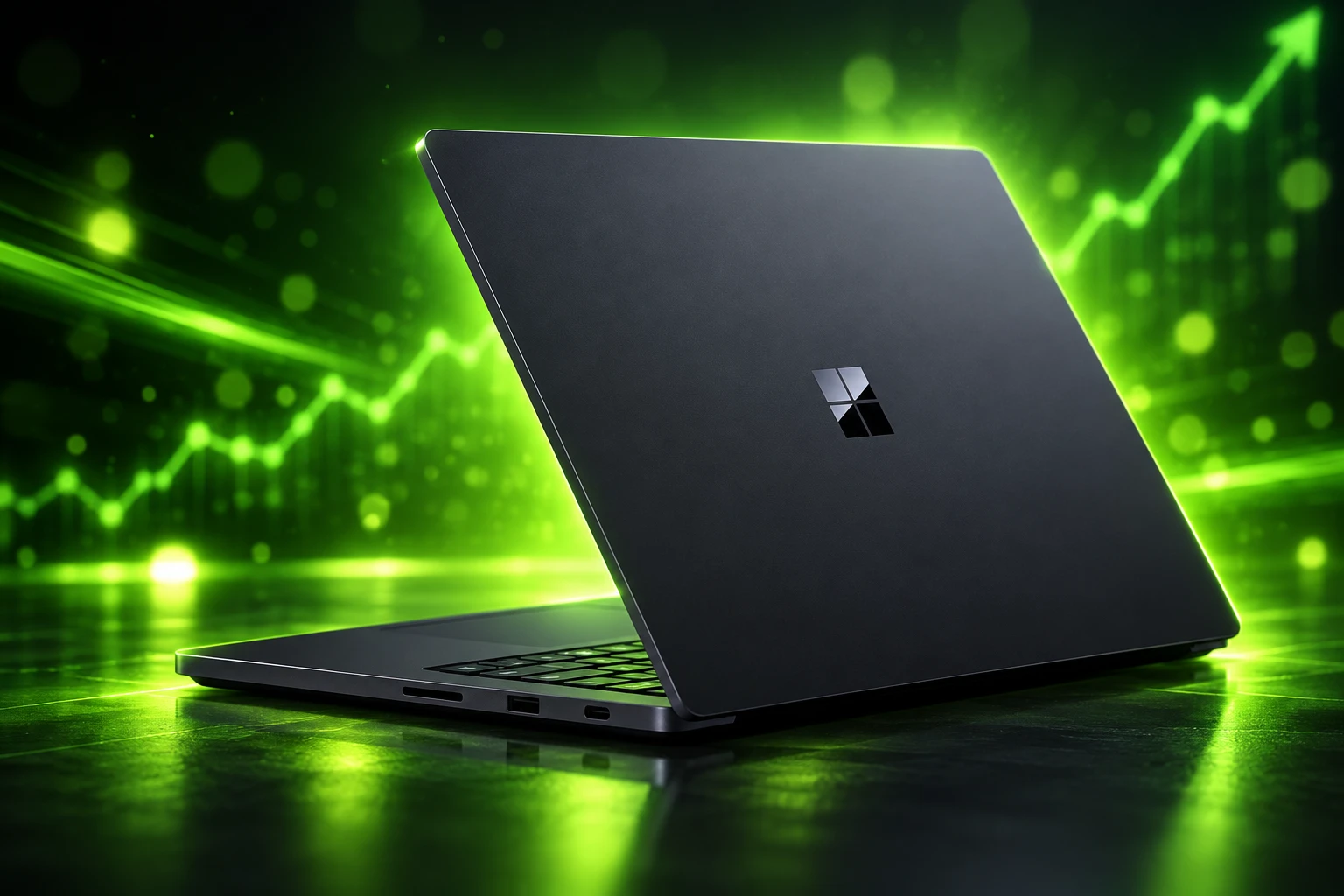
Microsoft opened pre-orders on October 7 for the Surface Laptop Ultra, a 15-inch NVIDIA RTX Spark laptop that starts at $2,599.99. That price buys an 18-core chip, 24GB of unified memory, a 512GB drive and Windows 11 Home.
The setup used to sell 120-billion-parameter local models is a $5,899.99 Nightfall unit with 128GB, listed for November 25. Windows 11 is also shipping the software that decides when those jobs should leave the machine.
$2,599 Buys 24GB and Windows 11 Home
The U.S. store configurations from $2,599.99 split the laptop into two NVIDIA RTX Spark N1X chips and five memory sizes. 24GB models ship with Windows 11 Home. Every 32GB to 128GB model ships with Windows 11 Pro.
The 18-core part, with a 5,120-core Blackwell GPU, tops out at 32GB. The 20-core part, with a 6,144-core GPU, is the only path to 48GB, 64GB and 128GB. Microsoft Store Exclusive tags sit on the 64GB and 128GB rows.
SURFACE LAPTOP ULTRA U.S. PRICES
| Chip | Memory / storage | Windows | Price |
|---|---|---|---|
| 18-core CPU, 5,120-core GPU | 24GB / 512GB | Home | $2,599.99 |
| 18-core CPU, 5,120-core GPU | 24GB / 1TB | Home | $2,999.99 |
| 18-core CPU, 5,120-core GPU | 32GB / 1TB | Pro | $3,299.99 |
| 20-core CPU, 6,144-core GPU | 32GB / 1TB | Pro | $3,699.99 |
| 20-core CPU, 6,144-core GPU | 48GB / 1TB | Pro | $3,999.99 |
| 20-core CPU, 6,144-core GPU | 64GB / 1TB | Pro | $4,299.99 |
| 20-core CPU, 6,144-core GPU | 64GB / 2TB | Pro | $4,699.99 |
| 20-core CPU, 6,144-core GPU | 128GB / 1TB | Pro | $5,899.99 |
Most pre-orders are listed for October 16. The 128GB Nightfall row is listed for November 25 if you pick express shipping, and it is the only way to pair 128GB with storage, which is capped at 1TB on that SKU. Jumping from the 64GB / 1TB row to 128GB adds $1,600. The 128GB laptop costs $3,300 more than the Home machine in the ads.
Overnight posts treated $2,599.99 as the 128GB laptop. The store does not. A 120-billion-parameter model at 4-bit precision needs on the order of 65GB for weights alone, before context, which is why the demo belongs to the late, expensive row.
Meet Surface Laptop Ultra. ⚡
Built around NVIDIA RTX Spark with up to 128 GB unified memory and the ability to run AI models exceeding 120B parameters locally.
Available for preorder today.https://t.co/lqm0cmTAQf pic.twitter.com/zwFjeV5qG1
— Windows Developer (@windowsdev) October 7, 2026
Windows Still Sends Heavy AI Work to the Cloud
Pavan Davuluri, executive vice president of Windows and Devices, wrote on October 7 that Microsoft is building hybrid intelligence on Windows, a setup where agents run locally when it makes sense and reach the cloud when they need to. The Surface product page is blunter: run local agents, keep sensitive work closer, and reserve the cloud for larger AI workloads.
That is the product, not a footnote. GitHub’s HydraFusion router, which already picks cloud models per task, is being extended to on-device models. Microsoft said an experimental preview is coming later in October in the GitHub Copilot app, the Copilot CLI and Visual Studio Code, with the pitch that local runs make tokens go further.
Copilot on Copilot+ PCs is due to pick up three local tricks in the coming months: read files and recent activity with permission, take actions on the PC, and call on-device models while still mixing in cloud models. Davuluri said Copilot+ PCs already run over 2 trillion local inferences a month, and that more than 40% of laptops being built for business are Copilot+ machines. The Ultra is the loud new chassis. The routing logic is the operating system.
Our goal is to deliver unmetered intelligence to every home and every desk with Windows. RTX Spark marks a real breakthrough towards that vision.
Satya Nadella, chairman and CEO of Microsoft, NVIDIA newsroom
To keep coding agents from wandering through personal files, Microsoft Execution Containers moved out of preview the same day. MXC is policy-driven containment for AI agents, so IT can say which files and networks an agent may touch and Windows enforces it at runtime. Session containers, which isolate an agent in its own desktop, clipboard and input, are Windows-only.
AGENTS ALREADY HOOKED TO MXC
- Shipping now: OpenAI Codex, GitHub Copilot, OpenClaw, Replit, LM Studio, NVIDIA OpenShell and Unsloth AI.
- Named as coming: Anthropic Claude Code, Perplexity, Raycast, Manus, Box, Egnyte and Meta’s Muse for Windows.
- Isolation range: process sandboxes, session containers, WSL, virtual machines and Windows 365 for Agents.
Local privacy is real inside those boxes. The same Windows build is still designed to ship the hard prompts out when the on-device model is not enough, which is the deal Microsoft is actually selling.
What the RTX Spark Superchip Puts on the Desk
RTX Spark is an Arm superchip: an NVIDIA Grace CPU, a Blackwell RTX GPU and a shared LPDDR5X pool. MediaTek worked on the CPU. NVIDIA rates the top part at up to 20 CPU cores and 6,144 GPU cores, linked at 600GB/s chip-to-chip. Microsoft’s store footnote says the famous 1 petaflop of AI performance is peak FP4 compute on select configs, using sparsity, and that real results vary by model, app and settings.
RTX SPARK, AS SOLD IN THIS LAPTOP
- Two N1X cuts: 18-core CPU with a 5,120-core GPU, or 20-core CPU with a 6,144-core GPU.
- Memory: 24GB, 32GB, 48GB, 64GB or 128GB of unified LPDDR5X, shared by CPU and GPU, with the GPU seeing less than the headline total.
- Local models: NVIDIA says 120-billion-parameter models with up to 1 million tokens of context; Microsoft showed GitHub Copilot, DaVinci Resolve and Gears of War: E-Day running together.
Jensen Huang, NVIDIA’s founder and CEO, framed the chip in May as a new PC. “The PC is being reinvented,” he said. “For forty years, you launched apps. Click. Type. With RTX Spark and Microsoft Windows, you ask, and the PC does the work.”
Microsoft is packing models to fit. MAI Code 1.1 Flash is 137 billion total parameters and 6.8 billion active, shrunk nearly 80% with 3-bit precision and a 256K local context window. An upcoming NVIDIA Nemotron model with over 70 billion parameters is quantized to 2-bit so it uses just over 20GB. DeepSeek V4 Flash is a 284-billion-parameter model Microsoft said can run on RTX Spark. Those fits are why 128GB is the SKU that matches the keynote, and why 24GB is a different computer.
ASUS, Dell, HP, Lenovo and MSI are also taking RTX Spark pre-orders, with Acer and GIGABYTE to follow. Surface is the house brand in a wider NVIDIA Windows push, not a one-off Halo notebook.
Memory Jumps $1,600, Then Slips to November
Unified memory is the product. NVIDIA’s May brief said RTX Spark can render 90GB-plus 3D scenes, edit 12K 4:2:2 video, generate 4K AI video and run those 120-billion-parameter models. That is not a 24GB Home workload. Microsoft even warns that the GPU cannot address the full 128GB, because Windows and the CPU sit in the same pool.
That bill shows up in a year when DRAM wafer space is going to HBM for data-center GPUs. IDC expects DRAM supply to grow about 16% in 2026, below older norms, with NAND around 17%. The Ultra’s own ladder is the cleaner receipt: Microsoft is charging $1,600 to double 64GB to 128GB, and it cannot ship that row with the October 16 wave.
THE SHIP CALENDAR MICROSOFT POSTED
- October 7, 2026: Pre-orders open after a San Francisco Windows and Surface event with Nadella and Huang.
- October 16, 2026: First Surface Laptop Ultra configs are listed to ship, from 24GB Home through 64GB Pro.
- Later in October 2026: HydraFusion local routing due in GitHub Copilot, Copilot CLI and VS Code as an experimental preview.
- November 25, 2026: 128GB Nightfall listed for express delivery; Copilot’s hybrid features are described only as coming in the following months on Copilot+ PCs.
A MacBook trade-in offer of up to $1,000 runs from October 7 through November 23, which covers the wait for high-memory units and still leaves the 128GB row as a full-price NVIDIA memory buy.
Magnetic Connect, a Mini-LED Panel, and a 140W Brick
The chassis is the part of the launch that does not need a cloud asterisk. Microsoft calls the charge jack the world’s first built-in magnetic USB-C port, branded Magnetic Connect: a full USB-C jack that lets go if the cord is yanked. The box includes a Surface 140W USB-C power adapter and a Magnetic Connect cable. The room cheered the port. The AI pitch is software.
The 15-inch PixelSense Ultra is a mini-LED touch panel at 3270 x 2180 (262 ppi), 3:2, up to 120Hz. Microsoft claims the brightest peak HDR of any laptop at 2,000 nits, measured over a 10% window with HDR content against machines on sale in October 2026. SDR is listed at 1,000 nits typical. The panel covers 100% DCI-P3 and supports Dolby Vision IQ. It is touch only. Surface pens are not supported.
Microsoft says the laptop is under 4.5 pounds and under 18 mm thick, in Platinum or Nightfall, with 2.5 times the thermal capacity of the 15-inch Surface Laptop (8th Edition). Storage is a removable SSD, 512GB, 1TB or 2TB. Battery figures on the business comparison sheet are up to 15 hours of local video and 12 hours of web use, from September 2026 tests on a preproduction 6,144-core unit with 64GB and 1TB.
PORTS AND BOX CONTENTS
- Left and right I/O: three USB-C ports, USB-A, HDMI, a full-size SD reader and a headphone jack.
- Charge: Magnetic Connect USB-C plus the 140W USB-C adapter in the box.
- Input: largest precision haptic touchpad Microsoft has put on a Surface, with click and hover feedback in Windows.
It is a dense, repairable 15-inch Windows box with CUDA, DLSS and a real HDMI port. That would be a straightforward creator laptop if the keynote had stopped at DaVinci Resolve and Gears of War: E-Day.
Nadella Wants Unmetered Intelligence on Every Desk
Unmetered intelligence is the line. The meter is still there. HydraFusion exists because cloud tokens are the bill Microsoft is trying to stretch, not erase. MXC exists because local agents are untrusted code sitting on the same disk as source and client files. The 128GB SKU exists because a 120-billion-parameter model does not fit in the $2,599.99 machine.
Brett Ostrum, corporate vice president of Surface, said the Ultra is for creators, developers and engineers who need serious performance in a portable Windows box. That buyer is real. So is the smaller audience that will actually pay $5,899.99 and wait until November 25 for the memory the demo used.
First boxes of the 24GB and 32GB configs are due October 16. The 128GB Nightfall config, the one that matches the 120-billion-parameter pitch, is the November 25 row on the same store page.

The $2,599 Surface Laptop Ultra Hides a $5,900 Machine

Universities Face a $70,000 Bill for Each OPT Nod

Contactless eGates Let British Faces Open UK Borders

Securitize Joins LG CNS to Wire Korea’s Token Rails

Meta Wrapped Muse in a Toy and Handed It the Keys

Nvidia’s $3.5 Billion MediaTek Deal Keeps Custom Chips Close

Pittsburgh Keeps Four Quarterbacks and Still Lacks a Successor

Pelacarsen Miss Hands the Lp(a) Bet to Amgen

Tony Romo’s OWI Plea Follows Him Into Every Car

POET Takes CPO Lasers to Shenzhen’s Optics Floor
-
 NEWS1 month ago
Nvidia’s $3.5 Billion MediaTek Deal Keeps Custom Chips Close
-
 NEWS1 month ago
Pittsburgh Keeps Four Quarterbacks and Still Lacks a Successor
-
 NEWS1 month ago
Pelacarsen Miss Hands the Lp(a) Bet to Amgen
-
 NEWS1 month ago
Tony Romo’s OWI Plea Follows Him Into Every Car
-
 NEWS1 month ago
POET Takes CPO Lasers to Shenzhen’s Optics Floor
-

 NEWS1 month ago
Shopify’s AI Push Pays Off Through Payments Mix
-

 NEWS1 month ago
Health-ISAC Warns ShinyHunters Is Walking Through Hospital Logins
-

 NEWS1 month ago
Australia’s Feed Prompts Leave the Algorithm Switched On