
BUSINESS
Haribo Scraps the Neuss Factory It Spent a Decade Planning
Haribo drops a €300m Neuss plant after almost ten years, keeps the Maoam works it called unexpandable, and still spends on factories abroad.

Haribo has cancelled a planned factory of about €300 million in Neuss after almost ten years of planning. The sweets maker will keep the older Maoam plant it had already judged too tight to expand.
A company spokesperson said global crises had disrupted supply chains and pushed up the cost of building materials, and that a project of this size needs certainty on both time and budget. Up to 100 extra jobs will not be created. About 350 people at the existing Maoam works keep their posts.
The Factory That Never Broke Ground
The new plant was meant to rise in the Neuss-Holzheim industrial park in North Rhine-Westphalia, about 5 km from the current Maoam site. Haribo told Mayor Reiner Breuer in person on 28 September 2026 that it would not build. Construction was supposed to start in 2025. Production was due in 2028. No shovel went in.
In May 2024 the company said it would buy a 14-hectare plot in Neuss-Holzheim and put about €300 million into a new sweets works. The Neuss city council backed the land sale on 28 June 2024. The city had reserved the ground for a producing tenant and planned two large halls, an office block, a loading yard and staff parking.
Maoam chews for the world already come out of Neuss. The new halls were meant to roughly double technical capacity against the old works, and in time to add Haribo fruit gums as well. After a spell of running both sites, the older plant was to be taken out of service around 2030.
THE NEUSS BUILD THAT STOPPED
- 1982: Maoam production sits in Neuss after Edmund Münster moves from Düsseldorf; Haribo later takes the brand.
- May 2024: Haribo announces about €300 million for a new Holzheim plant, with production aimed at 2028.
- 28 June 2024: The Neuss council approves the sale of the 14-hectare plot.
- 2025: The planned groundbreaking does not happen.
- 28 September 2026: Company leaders tell Mayor Breuer the new works is off.
Breuer had sold the 2024 deal with Haribo’s own slogan, saying the investment would make people in Neuss glad. The city says it will now market the ground again and that it takes no money hit from the walk-away.
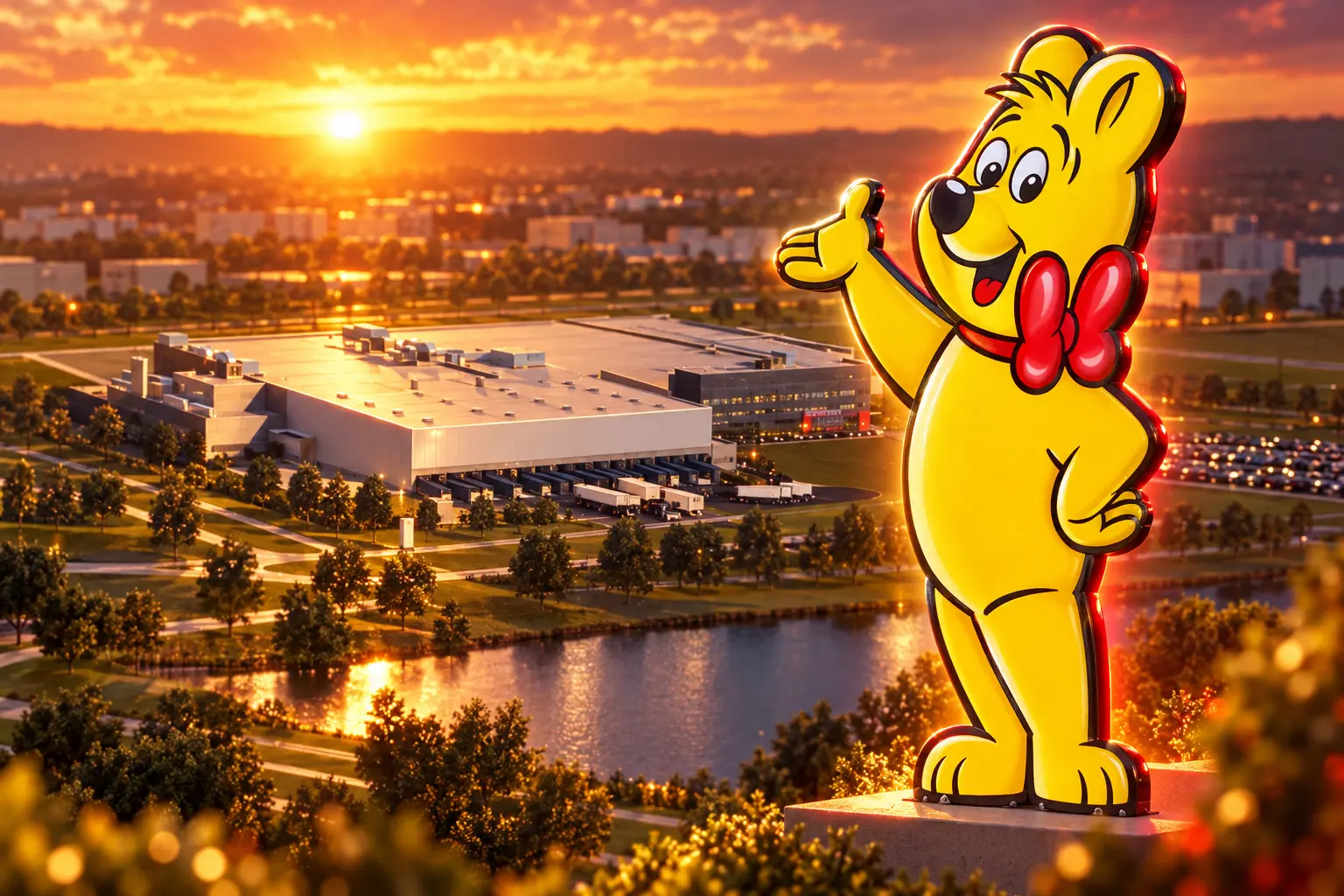
Haribo Now Backs the Unexpandable Plant
The 2024 case for Holzheim was blunt. The Jülicher Landstrasse site, near the centre of Neuss, had no room left for a sustainable, future-minded expansion. Demand for Maoam, the company said, had outgrown the halls. A new plant a short commute away was the fix.
That reading is now reversed. Haribo says the existing Neuss plant remains part of the family and central to its plans. It will modernise what it already owns instead of pouring a greenfield. Asked what the old site’s strategy now is, a spokesperson said the firm will work on a plan now.
In recent years, ongoing global crises have led to supply chain disruption and increases in the cost of building materials. A project of this size requires certainty, both in terms of timeframes and budget.
Haribo spokesperson, on the Neuss cancellation
A spokesperson also said that despite constructive work by all sides, including the city of Neuss, the company had put the scheme through a full fresh review. Under the new numbers it made more business sense not to go on. The same voice told staff the decision brings security, stability and clarity, even as the extra 100 posts disappear.
Building Costs Outran a Gummy Factory
Haribo is a German family firm headquartered in Grafschaft. It still makes sweets in Bonn, Solingen and Grafschaft as well as Neuss. If it will not pour about €300 million into a hall 5 km from an existing line, the barrier is not taste or brand. It is the bill for concrete, steel, time and risk.
The Federal Statistical Office’s price index for industrial buildings stood at 141.4 in the second quarter of 2026, with 2021 set at 100. That made industrial buildings 5% dearer than a year earlier, when the same index sat at 134.7. In the second quarter of 2024, just as Haribo went public with Holzheim, the industrial reading was 130.3.
GERMAN BUILDING PRICE INDEX, 2021 = 100
| Period | Industrial buildings | Change on year |
|---|---|---|
| Q2 2024 | 130.3 | +2.8% |
| Q2 2025 | 134.7 | +3.4% |
| Q2 2026 | 141.4 | +5.0% |
A Bertelsmann Stiftung note on public building budgets found that from 2010 to 2025 consumer prices rose about 43% while construction costs rose 60%, and building prices nearly doubled from 2010 to 2025. Haribo’s own line matches that ledger: materials ran short, prices jumped, and a multi-year factory could not be timed or costed with a straight face.
WHY THE GREENFIELD FAILED THE TEST
- Materials: The company cited shortages and higher prices for building supplies after years of global shocks.
- Time: Groundbreaking slipped through 2025 with no start on site.
- Budget: About €300 million was the 2024 figure; the firm says a project of that size now needs a cost path it can actually hold.
The old plant does not magically gain the floor plate Haribo said it lacked. It gains a stay, and a promise of stepwise upgrades whose size has not been published.
What Happens to the Maoam Jobs?
About 350 people stay on the Maoam line in Neuss. Ina Korte-Grimberg of the food union NGG said a works meeting was told that no post would be cut, unlike the pattern in other German industries. She still called the lost expansion a blow to the region.
The 100 extra jobs were the civic prize. They were tied to a bigger hall, not to a round of hiring at Jülicher Landstrasse. Fruit gums that were due to join Maoam in Neuss stay elsewhere in the group. Capacity that was meant to double against the current Maoam yard does not double.
WHAT THE CANCELLATION CHANGES ON THE GROUND
- New hiring: Up to 100 extra posts in Holzheim are off the table.
- Existing staff: About 350 Maoam jobs remain, with a pledge of no cuts.
- Output: The planned doubling of Maoam technical capacity, plus fruit gums in Neuss, does not arrive.
- Land: The 14-hectare Holzheim plot goes back to the city to offer again.
Some local voices tried to pin the death of the project on a Holzheim residents’ group that fought a zoning change next to housing. Haribo ruled that out on 28 September 2026. Thomas Nickel, a CDU councillor for the district, said talks with residents had stayed factual and that he had never believed a lawsuit was coming. The city still intends to keep the zoning change, so a later tenant can use a single large production plot.
Castleford Opened While Neuss Waited
Haribo is still spending on bricks. It is doing it where a factory already stands, and not on a German greenfield of this size.
On 25 June 2026 Haribo UK opened a £35 million Castleford warehouse and line in West Yorkshire, with an extra production and packing line beside a new store. The sites in Castleford and Pontefract employ more than 700 people. Phil Murphy, chief marketing officer for Haribo UK and Ireland, said the spend shows how much Yorkshire still carries the British business. Yvette Cooper, the local MP, cut the ribbon and pointed to those 700 jobs.
In 2023 the group started making Goldbears at its first U.S. factory in Pleasant Prairie, Wisconsin, a plant the company has described as its 16th, feeding a daily run it puts at more than 160 million Goldbears. That is expansion on ground already bought. Neuss-Holzheim was a new hall on city land that never saw a crane.
THREE HARIBO BETS, SIDE BY SIDE
| Site | Status | Jobs in play | What the money was for |
|---|---|---|---|
| Neuss-Holzheim | Cancelled, 28 September 2026 | Up to 100 new posts | About €300 million, new Maoam halls, later fruit gums |
| Neuss Maoam works | Staying open | About 350 kept | Stepwise modernisation, plan still unwritten |
| Castleford, UK | Opened 25 June 2026 | More than 700 at Castleford and Pontefract | £35 million warehouse plus an extra production and packing line |
Solingen remains the group’s biggest plant, with about 1,000 people and about 150 products. Bonn still makes sweets after the headquarters moved to Grafschaft in 2018. The German map is not empty. It is the new German hall that would not price.
Holzheim Goes Back on the Market
On 29 September 2026, as the Neuss news moved, McCain Foods said it would not pursue a planned frozen-potato plant in Mehrum, Lower Saxony, in its current form. That scheme had been talked up at up to €1 billion and up to 650 jobs. McCain pointed to inflation in project costs, spare capacity in processed potato products, and softer demand. Two food factories, two cost reviews, two German sites left without a hall.
The question that follows is not whether Germans still eat gummy bears. They do. It is whether a greenfield food plant of this scale can still be timed and paid for in Germany when even Haribo, at home, wants a budget it can lock. Retrofit is the remaining move: keep the Maoam crew, spend on the old envelope, and let Holzheim find another tenant.
A further talk with Holzheim residents is set for 12 October 2026. Mayor Breuer has said the city still wants Haribo in Neuss and will help with later work at the standing plant. Haribo has not put a figure on that modernisation. The certainty it said a new factory required is, for now, the factory it already has.
Frequently Asked Questions
Why Did Haribo Cancel the New Neuss Factory?
The company said that since planning began, world economic conditions had changed at the root, with global crises tightening building materials and lifting international prices, so a project of this size could no longer be given a reliable time and cost frame; after a full review it called dropping the new build the sounder business choice.
Is the Old Maoam Plant in Neuss Closing?
No. Haribo has reversed the 2030 shutdown that sat in the 2024 roadmap, says the Jülicher Landstrasse works stays in use with its workforce, and has only promised a later modernisation plan rather than a move or a closure date.
Where Else Does Haribo Make Sweets in Germany?
Besides Neuss, the company lists manufacturing in Bonn, Solingen and Grafschaft; Solingen is the largest of those plants, with about 1,000 people and about 150 product lines for German and export orders.
Did Local Protests Kill the Holzheim Project?
Haribo said on 28 September 2026 that they did not, and councillor Thomas Nickel said talks with the Holzheim residents’ group had stayed on the facts; the published reasons are materials, prices and the lack of a cost path the firm would sign.

The $2,599 Surface Laptop Ultra Hides a $5,900 Machine

Universities Face a $70,000 Bill for Each OPT Nod

Contactless eGates Let British Faces Open UK Borders

Securitize Joins LG CNS to Wire Korea’s Token Rails

Meta Wrapped Muse in a Toy and Handed It the Keys

Pittsburgh Keeps Four Quarterbacks and Still Lacks a Successor

Nvidia’s $3.5 Billion MediaTek Deal Keeps Custom Chips Close

Pelacarsen Miss Hands the Lp(a) Bet to Amgen

Tony Romo’s OWI Plea Follows Him Into Every Car

Shopify’s AI Push Pays Off Through Payments Mix
-
 NEWS2 months ago
Pittsburgh Keeps Four Quarterbacks and Still Lacks a Successor
-
 NEWS2 months ago
Nvidia’s $3.5 Billion MediaTek Deal Keeps Custom Chips Close
-
 NEWS2 months ago
Pelacarsen Miss Hands the Lp(a) Bet to Amgen
-
 NEWS2 months ago
Tony Romo’s OWI Plea Follows Him Into Every Car
-
 NEWS2 months ago
Shopify’s AI Push Pays Off Through Payments Mix
-

 NEWS2 months ago
POET Takes CPO Lasers to Shenzhen’s Optics Floor
-

 NEWS2 months ago
Health-ISAC Warns ShinyHunters Is Walking Through Hospital Logins
-

 NEWS2 months ago
Australia’s Feed Prompts Leave the Algorithm Switched On